Getting deals · for creators
Pay-Per-View Campaigns Explained for Creators
- A pay-per-view rate (CPM) pays per 1,000 views — read it together with the base fee, cap and minimum, not alone.
- Most individual posts earn far less than the headline rate suggests, since most posts get modest views.
- Per-view deals suit creators who post often; a flat fee suits a single deliverable you'd rather not tie to performance.
A pay-per-view campaign pays you a rate for every 1,000 views a post gets, instead of one flat fee no matter how it performs. That rate is called a CPM. Your take-home also depends on a base fee, a cap on one post's earnings, and a minimum view count it must clear first.
The honest complication is that views aren't spread evenly across your posts. A small share of your posts will do almost all of the earning. Most will do very little. That changes how you should read a campaign's rate before you apply.
What the four settings actually mean
The rate, usually written as a CPM, is what you're paid per 1,000 views once a post qualifies. The base fee is a flat amount paid on every approved post, regardless of views — it covers the work itself, not the reach.
The cap is the most a single post can earn, no matter how far it travels. It protects the brand's budget from one runaway hit. The minimum is the view count a post must clear before it earns anything at all. Below it, the post pays nothing.
All four together decide what a campaign is really worth to you. None of them show up in the headline rate a campaign advertises.
How a payout is actually calculated
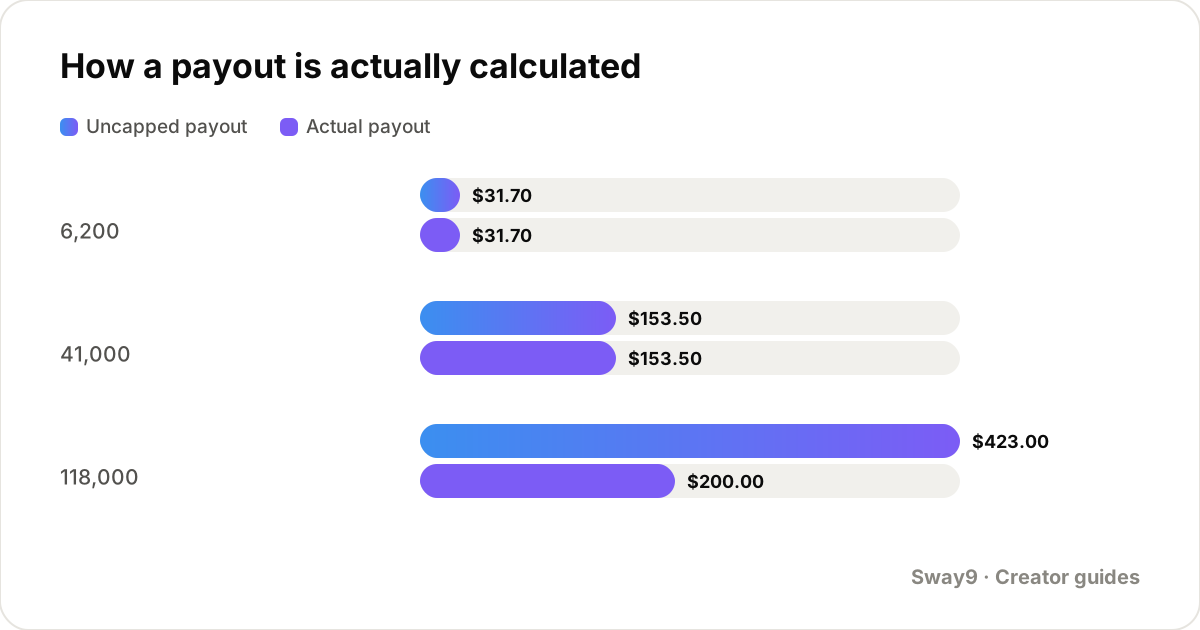
Say a campaign pays a $3.50 CPM, a $10 base per post, a $200 cap, and has a 1,000-view minimum. You post three clips.
| Post views | Uncapped payout | Actual payout |
|---|---|---|
| 6,200 | $31.70 | $31.70 |
| 41,000 | $153.50 | $153.50 |
| 118,000 | $423.00 | $200.00 |
The part most campaign pages don't explain
We looked at 159 tracked posts across two real pay-per-view programs. The median post got 307 views. 97% of posts came in under 1,000 views. The top 10% of posts drove 26.3% of all views in the sample.
That's one sample, not a universal law. But the shape of it — a small number of posts carrying almost all the reach — is what people who run these campaigns consistently describe.
Run that median through the campaign above. A 307-view post clears a 1,000-view minimum only if that minimum were lower. If the minimum were 250 instead of 1,000, a median post would earn $10 base + ($3.50 × 0.307) = about $11.07. Without the base fee, that same post earns about a dollar.
This is why the base fee and the minimum matter as much as the CPM itself. A high rate on a campaign with no base and a steep minimum can pay less than a modest rate with a small base and a low minimum. It depends on where your typical post actually lands.
When per-view pays off, and when a flat fee is better
Per-view deals reward volume and consistency. Post often enough, and the campaign's own outliers do the heavy lifting for your total. They suit creators who can make many posts a month and are fine with earnings that swing post to post.
A flat fee is better for a single deliverable you won't repeat, or when you'd rather know the exact number in advance than gamble on reach.
Reading a campaign card before you apply
Run your own last several posts' view counts through a campaign's stated terms before you apply, the same way the worked example above does. It takes two minutes and tells you more than the headline rate ever will.
- The rate — but only as a starting point, not the answer
- The base fee, and whether it exists at all
- The cap, checked against your own best-case views for this kind of content
- The minimum, checked against your typical post, not your best one
Volume is the lever that actually moves your total
Most posts earn modestly, and a handful carry the total. Given that, how many posts you make in a month matters more than the exact rate you picked. Ten posts a month gives the distribution almost nothing to work with. Forty gives it room to produce an occasional hit.
The same logic applies across accounts, if you run more than one. A second account in a different niche adds more chances for a post to land in that top tier. Posts that don't travel cost you very little beyond the time to make them, especially once a base fee is in play.
Keeping track once you're in several campaigns at once
Once you're applying to more than one or two pay-per-view campaigns, redoing this arithmetic by hand for every post gets old fast. Each deal has its own rate, base, cap and minimum. Each post's views keep changing after it goes live.
Logging each brand deal with its own rate helps. So does letting the daily view count update on its own. That's the difference between guessing at a month's total and actually knowing it before the brand's payment lands.
Frequently asked questions
What is a typical CPM for a pay-per-view campaign?
General consumer content commonly runs $0.50 to $2.00 per 1,000 views. Specialized or harder-to-produce niches pay more. Read the rate together with the base fee, cap and minimum, not on its own.
Why did my post earn nothing on a per-view campaign?
Almost always a minimum view count the post didn't clear. Check the campaign's stated minimum against your typical post's views before you apply, not after.
Is a per-view deal worse than a flat fee?
Neither is universally better. A flat fee is more predictable for a single deliverable. A per-view deal rewards volume, and can pay considerably more if you post often and some posts travel.
What is effective CPM?
Your total payout divided by your total views, times 1,000. It's what a campaign actually paid you per 1,000 views once the base fee, cap and minimum have all applied. It's the number worth comparing across campaigns.
Should I chase the highest advertised rate?
Not on its own. A high rate with a low cap and a steep minimum can pay less than a modest rate with a small base fee and no minimum. Run your real view pattern through both before picking one.
Track your own accounts
Add your TikTok and Instagram handles, set each brand deal up as a campaign with its rate, and Sway9 pulls in every post and view and works out what the deal is worth. From $22/mo, cancel any time.
Get started Cancel any time · unlimited team members on every planSources: Sway9 CPM benchmark study · How much do clippers make per 1,000 views · How to pay creators per view