How to pay creators per view: rates, caps and minimums
Paying per view sounds simple — pick a price per 1,000 views and let the numbers do the rest. In practice four settings decide whether a campaign is fair to both sides and predictable to budget: the rate, a base fee, a cap, and a minimum.
CPM or flat fee?
A flat fee pays a fixed amount per approved post. It is predictable, easy to explain, and appropriate when you are buying a deliverable — a specific script, a product demo, an asset you will re-use in ads.
A CPM pays per 1,000 views, so your cost tracks the result. It is the better structure when you are buying reach rather than a specific asset, and it is what most clipping and UGC-at-volume programs use. It also scales in the right direction: posts that fail cost you almost nothing, and posts that work are worth paying for.
Typical market rates in 2026 sit around $0.50–$2.00 per 1,000 views for general consumer content, with specialised or harder-to-produce niches paying more. Rates vary a lot by category, so treat those as a starting bracket, not a benchmark.
Why a base fee per post matters
Pure CPM has a fairness problem at the bottom of the distribution. Most posts in any creator program do modestly — in our own tracked data, 97% of posts came in under 1,000 views. On a $1 CPM, a 400-view post earns 40 cents, which is not a serious payment for real work.
A small base per post — paid on every approved post on top of the CPM — fixes that. It says "the work has value, and reach has more value." It also keeps good creators from churning out after one unlucky post.
Caps: the setting that protects your budget
A cap per post is the most a single post can earn regardless of how far it travels. Without one, a genuine outlier can consume a whole month's budget in a day. With a $100 cap on a $1 CPM, a post stops earning at 100,000 views.
Caps are a trade-off, and worth being honest with creators about: they limit the upside on exactly the posts that helped you most. Set them high enough that a real hit still feels rewarded.
Minimum views: a floor, not a filter
A minimum view count means a post earns nothing until it clears the floor. It exists to stop payouts for content that reached nobody. Keep it low — a minimum set above the median post is effectively a way of not paying most of your roster, and creators notice.
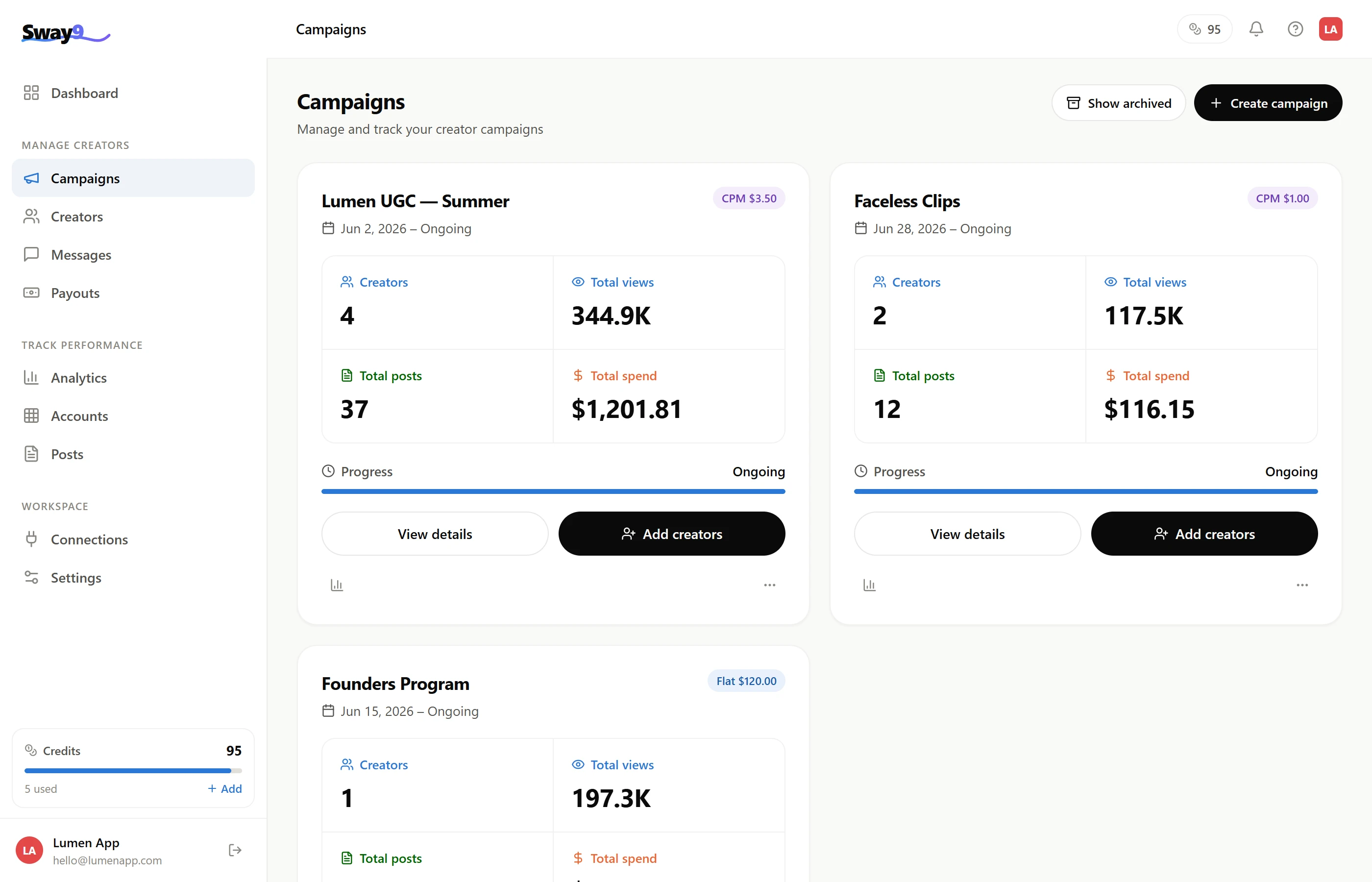
A worked example
Say you set a $1.50 CPM, a $5 base per post, a $150 cap, and a 500-view minimum. Then:
| Post views | What it pays | Why |
|---|---|---|
| 300 | $0.00 | below the 500-view minimum |
| 800 | $6.20 | $5 base + $1.20 of views |
| 12,000 | $23.00 | $5 base + $18.00 of views |
| 200,000 | $150.00 | $305 earned, capped at $150 |
Two things fall out of that table. First, the base fee dominates at the bottom and is irrelevant at the top — which is exactly what you want. Second, your effective CPM (total spend ÷ total views × 1,000) will not equal your headline rate. Minimums push it down, base fees push it up, and caps pull it down hard once you have a hit. Effective CPM is the number to judge a campaign on.
Guardrails worth having
- Verify handles. Ask creators to prove they own the account they're claiming, so payouts cannot be pointed at someone else's content.
- Read views from the platform, not from screenshots. A screenshot is a claim; a public view count fetched from the post is evidence.
- Look at engagement rate, not just views. A post with 50,000 views and 40 likes deserves a second look.
- Re-check numbers over time. View counts move after posting, both up and (occasionally, when posts are removed) down.
- Approve applications yourself at first. Auto-approval is convenient once you know what a good applicant looks like.
How to pick your first rate
- Start from what a view is worth to you. If 1,000 views reliably produces one $10 subscriber, a $2 CPM is cheap. If you have no idea yet, start low and raise it.
- Set the base to about what a post takes to make at the low end — a few dollars for a slideshow, more for a filmed piece.
- Cap at roughly 20–50× your base so a hit is clearly worth chasing.
- Set the minimum below your expected median so a typical post still earns.
- Review effective CPM after two weeks and adjust one setting at a time.
Frequently asked questions
What is a good CPM for UGC creators?
General consumer content in 2026 commonly pays around $0.50 to $2.00 per 1,000 views, with specialised niches paying more. The right number depends on what a view is worth to your product, so start from your own economics rather than a benchmark.
Should I pay per view or a flat fee per post?
Pay per view when you are buying reach and want cost to follow results. Pay flat when you are buying a specific deliverable you will re-use, such as an ad asset.
How do I stop one viral post from blowing my budget?
Set a cap per post — the maximum a single post can earn no matter how far it travels. Set it high enough that a genuine hit still feels rewarded.
What is effective CPM?
Total spend divided by total views, times 1,000. It is what you actually paid per 1,000 views once base fees, caps and minimums have all applied, and it is the number to judge a campaign on.
Model your campaign before you launch it
Set a rate, base, cap and minimum, and see exactly what each post would pay.
Open the CPM calculator