How much do clippers actually make per 1,000 views?
Clipping campaigns advertise a rate per 1,000 views, which makes the maths look easy. The rate is the easy part. What decides your actual income is the shape of the view distribution — and almost nobody explains that before you start.
The rates you'll actually see
Across pay-per-view campaigns in 2026, general consumer content tends to pay around $0.50 to $2.00 per 1,000 views. Specialised, harder-to-produce or higher-value niches pay more. Brands budget anywhere from a few hundred to tens of thousands per campaign, and the per-view rate usually reflects how valuable a viewer is to them, not how much effort the clip took.
So a post at 40,000 views on a $1 CPM earns $40. At $0.50 it earns $20. That part is simple arithmetic and every campaign card states the rate before you apply.
The part that actually determines your income
Views are not distributed evenly, and the gap between the average post and the good post is enormous. We looked at 159 posts across two of our own app campaigns and found:
- the median post got 307 views
- 97% of posts came in under 1,000 views
- the top 10% of posts drove 26% of all views in the program
That is one small sample from two apps, not a law of nature — but the shape is what everyone who runs these campaigns describes. Most posts do very little. A few do most of the work.
Which means: a $1 CPM on a median 307-view post is 31 cents. If you are picking campaigns purely on the headline rate, you are optimising the wrong number.
What moves your earnings, in order
- Volume. If a small share of posts carry your income, you need enough posts for that share to exist. Ten posts a month gives the maths almost nothing to work with.
- Hook quality. Views are decided in the first two seconds far more than by anything after. This is the one skill with real compounding returns.
- Format-market fit. Some niches simply travel further. Watch which of your own posts outperform and make more of those.
- Campaign fit. A campaign whose audience overlaps yours will outperform a higher-rate campaign that doesn't.
- The rate. Real, but last. Doubling your CPM on posts that get 300 views changes very little.
Read the cap and the minimum before you apply
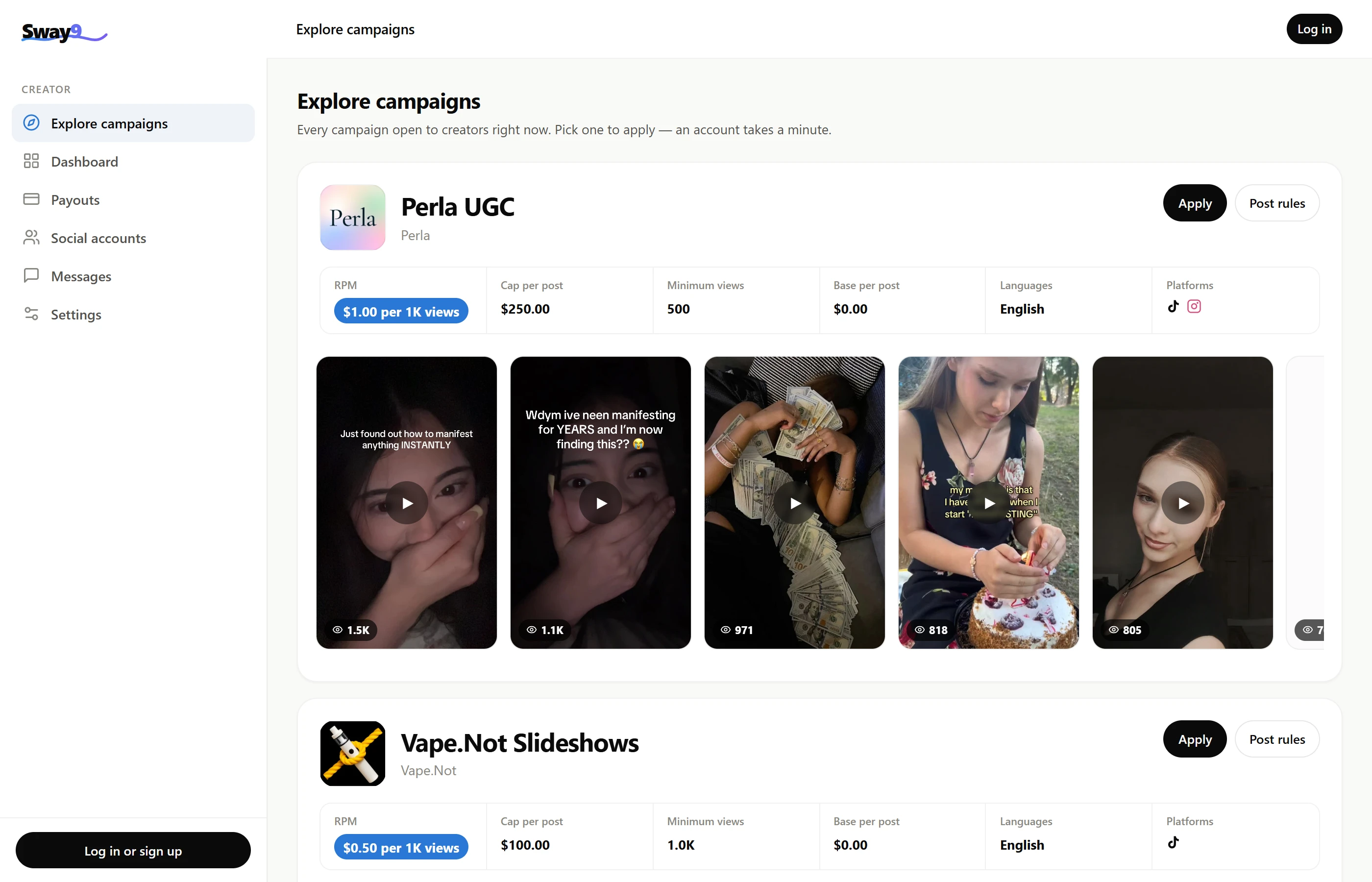
Two settings decide what a campaign really pays, and both are visible on the campaign card:
- Cap per post — the ceiling on a single post. A $100 cap on a $1 CPM means your post stops earning at 100,000 views. If you regularly break a million, that campaign is worth much less to you than the rate suggests.
- Minimum views — the floor a post must clear to earn anything. A 1,000-view minimum on a campaign where most posts get 300 views means most of your posts earn zero.
A $2 CPM with a 5,000-view minimum can easily pay you less than a $0.50 CPM with no minimum. Do that comparison before you apply, not after.
A realistic month
Suppose you post 40 clips in a month to a $1 CPM campaign with a $5 base per post and no minimum, and your distribution looks like the sample above: most posts a few hundred views, three or four that break 20,000, one that hits 150,000.
The base fees alone are $200. The long tail of small posts might add $15. The three mid-hits add maybe $70. The outlier adds $150 (or less, if there's a cap). That's roughly $435 — and note that more than half of it came from the base fee and one video. Remove the base fee and the same month pays about $235.
This is why base fees matter so much to creators and why campaigns that offer one are usually worth prioritising.
How to pick campaigns
- Filter for no minimum, or a low one.
- Prefer campaigns with a base per post.
- Check the cap against your own best-case views.
- Pick subjects you can post about repeatedly without running dry.
- Apply to several. Approval is not guaranteed, and how you apply matters.
Frequently asked questions
How much do clippers make per 1,000 views?
Commonly $0.50 to $2.00 per 1,000 views in 2026, with specialised niches paying more. Your actual income depends far more on how many posts you make and how many of them travel than on the rate itself.
Can you make money clipping with no followers?
Yes — pay-per-view campaigns pay for views, not followers, and most have no follower minimum. A new account with a video that reaches 50,000 people earns more than a large account whose post reaches 3,000.
Why did my post earn nothing?
Usually a minimum view count: many campaigns require a post to clear a floor before it earns. Check the campaign card for the minimum, and whether there is a base fee per post.
Is clipping worth it?
It depends on volume. If you can post consistently and improve your hooks, the outliers make it worthwhile. If you can only manage a handful of posts a month, the maths rarely works.
Compare live campaigns yourself
Rates, caps and minimums, all visible before you apply. Free to join.
Browse open campaigns