Rates · for creators
How Much Is 100,000 Views Worth
- A plain $0.50 to $4.00 CPM on 100,000 views is worth $50 to $400 before any base fee, cap or minimum applies.
- A cap can cut that same post's payout dramatically; a base fee adds a fixed amount regardless of views.
- A single post reaching 100,000 views is unusually large — most posts in tracked campaigns land far below that.
100,000 views on its own has no fixed dollar value. It's worth $50 under one deal and well over $1,000 under another. The deal type and its terms decide the payout far more than the view count does.
The only honest way to answer the question is to run the same 100,000 views through several real deal structures, and show the arithmetic for each. Below is a full set of scenarios: a simple per-view rate, base fees, caps, flat fees, and a retainer-equivalent. All of them work from the identical 100,000-view figure, so the comparison is direct.
None of these numbers are a benchmark to expect by default. They're simply what 100,000 views produces once you plug it into each structure. Check any real offer against the correct row instead of against a single headline figure.
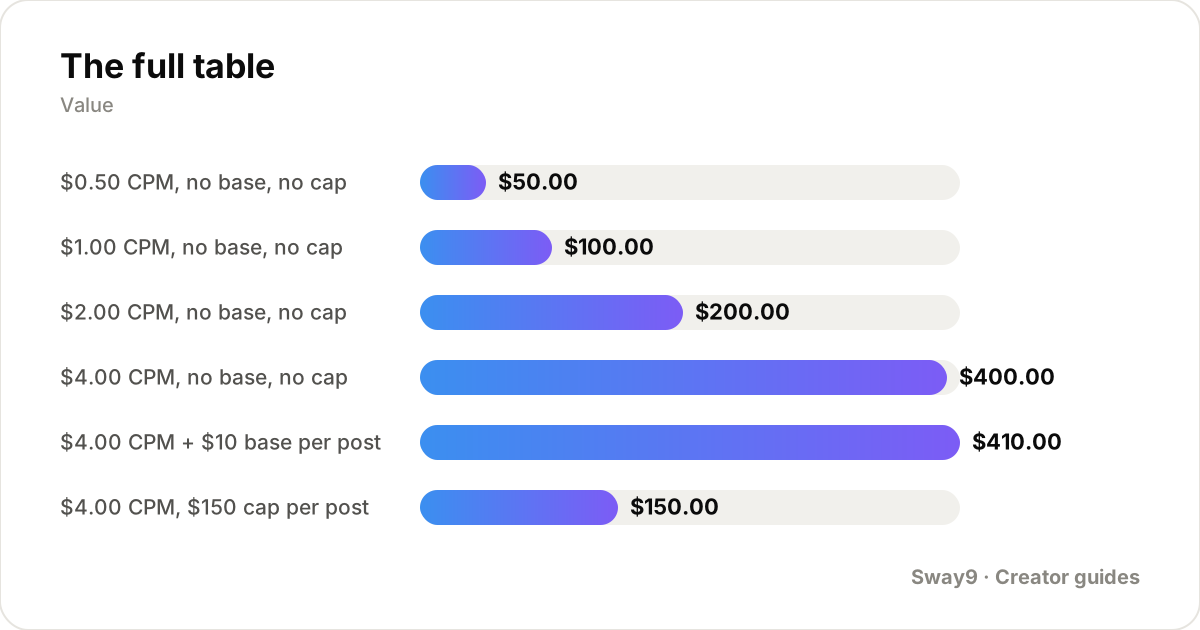
The full table
Every row below assumes the same 100,000 views, achieved by a single post unless stated otherwise. Only the deal terms change from row to row.
| Deal type and terms | Arithmetic | Value |
|---|---|---|
| $0.50 CPM, no base, no cap | 100 × $0.50 | $50.00 |
| $1.00 CPM, no base, no cap | 100 × $1.00 | $100.00 |
| $2.00 CPM, no base, no cap | 100 × $2.00 | $200.00 |
| $4.00 CPM, no base, no cap | 100 × $4.00 | $400.00 |
| $4.00 CPM + $10 base per post | $400 + $10 | $410.00 |
| $4.00 CPM, $150 cap per post | $400 uncapped, stopped at cap | $150.00 |
Two more scenarios, for comparison
A flat fee and a retainer don't fit neatly into the CPM table above, since neither one prices per view directly. Here's how each one compares at the same 100,000 views.
Why the same views produce such different numbers
A CPM with no base and no cap scales in a straight line. Double the rate, double the payout, at any view count. That's the simplest case, and the one most people picture when they hear "pay per view."
A base fee changes the bottom of the range, not the top. It matters enormously on a 300-view post. It's almost invisible once a post reaches 100,000 views. That's the whole point of a base fee: it protects the low end without costing much at the high end.
A cap does the opposite. It's invisible on a small post and dominates a large one. A $150 cap on a $4.00 CPM deal means every post past 37,500 views earns exactly $150, no matter how much further it travels. A post with 100,000 views and one with 500,000 views pay the same $150 under that cap.
Flat fee versus per-view, at 100,000 views specifically
A flat fee of $300 per post pays $300 whether the post gets 3,000 views or 100,000. Compared against a $4.00 CPM alternative with no cap, the CPM deal wins decisively at 100,000 views: $400 versus $300.
But the flat fee would have won on a smaller post. At 30,000 views, the CPM deal only pays $120 against the flat fee's $300.
What a retainer's equivalent rate looks like
A retainer's effective rate is useful for comparing it against a straight per-view offer, even though the retainer itself isn't priced as a CPM. The math for that $1,500 retainer sits in the scenarios section above.
That effective rate moves a lot month to month, if the retainer's views vary — and that's normal. A retainer trades some of that variance for a fixed, predictable total.
Where 100,000 views actually sits in the real distribution
In a tracked sample of 159 posts across two pay-per-view programs, the median post got only 307 views. 97% of posts came in under 1,000 views. The top 10% of posts drove 26.3% of all views in the sample. A single post reaching 100,000 views would sit deep inside that top slice, not anywhere near typical.
That context matters when you're quoting or comparing rates. The $400 and $410 rows in the table above describe an unusually good outcome, not the outcome to plan your monthly income around. Budget from your median post's views, and treat a 100,000-view result as the upside case it actually is.
It also explains why campaigns set a cap where they do. A brand offering a $150 cap on a $4.00 CPM deal isn't being stingy about a routine outcome. They're limiting the rare case where a post reaches deep into that top slice. Everything below the cap's threshold — the overwhelming majority of posts — still gets the full rate.
Using this when you're quoting a rate
When a brand asks what a post is worth, run their proposed terms through your own typical view count first. Then check what the same terms would pay at 100,000 views, as the upside case.
If the gap between those two numbers is mostly base fee and cap, you're looking at a deal built for consistency. If it's mostly CPM, it's built to reward a hit instead. Neither is wrong, but know which one you're agreeing to before you sign.
Frequently asked questions
So how much is 100,000 views actually worth?
Anywhere from $50 to over $400 on a straight CPM deal, depending on the rate. More or less once a base fee or cap applies. Or a fixed flat amount unrelated to the view count at all. There's no single answer without knowing the deal type.
Is 100,000 views on one post a lot?
Yes. In tracked pay-per-view programs the median post gets around 307 views. A single post reaching 100,000 sits well inside the small top slice of posts that do most of the work in any campaign.
Does a cap really change the answer that much?
It can. A $150 cap on a $4.00 CPM deal pays the same $150 whether a post gets 100,000 views or 500,000. Every view past the cap's threshold stops adding to the payout.
Should I aim for CPM deals or flat fees if I sometimes get 100,000-view posts?
Compare the crossover point for the specific terms on offer. Above it, a CPM deal usually pays more. Below it, a flat fee usually does. Your own typical view count tells you which side you land on most months.
Does a base fee matter at 100,000 views?
Barely. A $10 base fee added to a $400 CPM payout is a small fraction of the total. That's the opposite of its effect on a small post, where the same $10 can be most of what the post earns.
Track your own accounts
Add your TikTok and Instagram handles, set each brand deal up as a campaign with its rate, and Sway9 pulls in every post and view and works out what the deal is worth. From $22/mo, cancel any time.
Get started Cancel any time · unlimited team members on every planSources: Sway9 CPM benchmark study · How much do clippers make per 1,000 views