Rates · for creators
Which Content Earns You the Most per View?
- Compute effective CPM per post — payout divided by views in thousands — rather than ranking posts by raw view count.
- Compare at the level of format and account, not just individual posts, since one outlier post can skew a whole category.
- This only works with data you actually track: views, payout, and which deal each post belonged to, recorded consistently.
The format or account that earns you the most per view is not the one with the biggest view counts. It's the one with the highest effective CPM — what you actually earned per 1,000 views. You get that number by dividing what a post paid by how many views it got, in thousands.
A post with 40,000 views on a flat $100 fee earned $2.50 per 1,000 views. A post with 8,000 views on a $4 CPM deal earned exactly $4 per 1,000 views, paying $32 in total. That's less overall, but a better rate. Ranking by views alone would put the wrong one on top.
Below is how to compute this from your own post history, a worked comparison across five posts, and what to do once you know which one wins.
Why raw views rank the wrong post first
Views measure reach, not what you were paid for that reach. The two only line up when every post is on an identical CPM, with no flat fees and no floors — rarely true across a real body of work. A flat-fee post, a CPM post, and a CPM-plus-floor post can all show similar view counts while paying very different amounts.
The fix is one consistent measure: effective CPM, computed the same way for every post no matter how the original deal was structured. Effective CPM equals payout divided by views in thousands. It turns every post into one comparable number.
Worked comparison across five posts
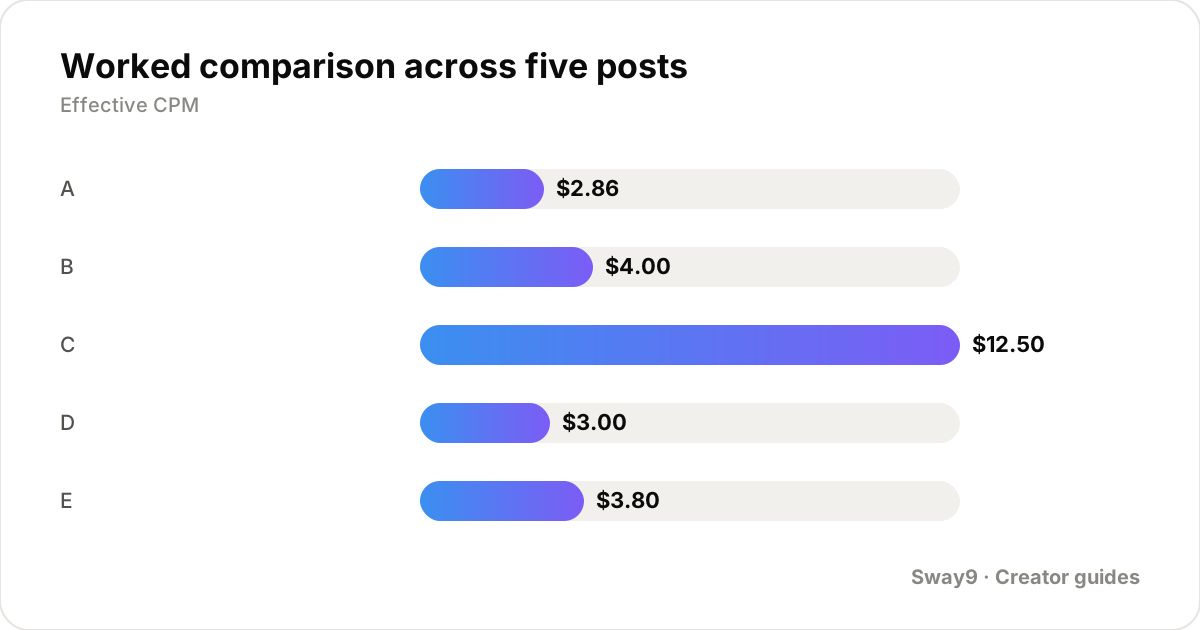
Take five posts across two accounts — a main TikTok and a niche second TikTok — and two formats: a skit-style video and a straightforward product demo. Each has a different original deal structure. Effective CPM makes them directly comparable.
| Post | Account | Format | Views | Payout | Effective CPM |
|---|---|---|---|---|---|
| A | Main | Skit | 42,000 | $120 flat | $2.86 |
| B | Main | Demo | 9,500 | $4 CPM | $4.00 |
| C | Niche | Skit | 3,200 | $40 flat | $12.50 |
| D | Niche | Demo | 2,100 | $3 CPM | $3.00 |
| E | Main | Demo | 15,800 | $60 flat | $3.80 |
Reading the comparison: format and account, not just one post
Looking at effective CPM alone, Post C is the standout. It's a niche-account skit that paid $12.50 per 1,000 views, against $2.86 to $4.00 for everything else. Before concluding 'niche account skits win,' check whether that's a pattern or one lucky post. With only one skit-format post on the niche account here, it's too early to call it a trend.
What the comparison does support is the demo format on the main account. Posts B and E are both demo content on the same account, landing at $4.00 and $3.80. That's consistent enough to call the combination reliably solid, even though neither is the single highest number in the table. A consistent pairing across multiple posts beats one good-looking outlier.
Why one standout post can be misleading
Sway9's own tracking data, across 159 posts, found the top 10% of posts made 26.3% of all views. The median was just 307 views per post overall. That same skew shows up in earnings, not just views. A handful of posts, whether from a generous flat fee or a lucky view spike, can post an effective CPM well outside your typical range.
Treating that post as proof of a winning format is how creators end up chasing a style that doesn't repeat. The more reliable read is the median effective CPM for a format or account across several posts, not the single best one. If a format only has one or two data points, treat any conclusion as tentative.
What changes once you know which combination wins
Once a format-account combination shows a consistently higher effective CPM across several posts, two things are worth doing. First, weight future pitches toward it — if a brand is open to either format, propose the one your own data says performs better for you specifically.
Second, use the number in a negotiation. 'My demo content on this account has landed around a $4 effective CPM across the last several deals' is a concrete anchor a brand can respond to. It's also worth checking the reverse: a consistently low effective CPM for a format or account is a signal to renegotiate that rate, or deprioritize it.
How often to redo the comparison
This isn't a one-time analysis. A format or account with the best effective CPM after ten posts can shift once twenty or thirty are in, especially for a newer format with less history. Redo the comparison every few months, or after each batch of new posts. That's enough to catch a real shift without overreacting to any single new data point.
It's also worth rerunning the comparison whenever your rate structure changes — moving from mostly flat fees to mostly CPM deals, for instance. That changes what 'payout' means per post, and it's exactly the kind of shift that makes an old comparison stale.
What this needs from your tracking to actually work
This comparison needs views and payout recorded per post, tied to which account and which deal each post belonged to. That's exactly the data a spreadsheet tends to lose once it's split across a deals tab and a performance tab that don't stay in sync.
In Sway9, each brand deal is set up as a campaign with its rate. The app pulls views for connected accounts automatically, up to three times a day, with a per-post daily history. That means the views half of this arithmetic doesn't need checking and pasting by hand.
CSV export covers pulling the full history out to run this comparison yourself. Unlimited campaigns and posts means it holds up at five posts or five hundred.
Frequently asked questions
How many posts do I need before I can trust a format comparison?
There's no strict cutoff, but treat anything based on one or two posts as tentative, not a confirmed pattern. A single well-negotiated flat fee or a lucky view spike can make a format look better than it typically is. A handful of posts on the same format-account combination, landing in a similar range, is a stronger basis for a conclusion.
Should I compare effective CPM across different platforms too?
Yes, the same calculation applies regardless of platform. Payout divided by views in thousands works whether the post is on TikTok or Instagram. Keep the platform as a column in the comparison, rather than assuming a rate on one platform translates directly to the other, since typical view counts often differ.
What if a post had a CPM deal with a floor — how do I compute effective CPM then?
Use the actual payout, whichever way it came out. If the floor applied because views were low, use the floor amount. If the CPM exceeded the floor, use the CPM-based payout. Either way, effective CPM is still payout divided by views in thousands, using whatever you were actually paid.
Does a higher effective CPM always mean a better deal?
It means a better rate per view, which is one part of a deal's value, not the whole picture. A flat-fee deal with a high effective CPM but very low views might still pay less in total than a lower-CPM deal on a bigger account. Check both numbers before deciding a combination is worth prioritizing.
Is it worth comparing effective CPM against other creators, not just my own posts?
Your own historical data is the more actionable comparison, since it reflects your specific accounts, audience, and negotiating position. A broad industry number can be a useful sanity check. It won't tell you which of your own formats or accounts is actually performing best for you.
Track your own accounts
Add your TikTok and Instagram handles, set each brand deal up as a campaign with its rate, and Sway9 pulls in every post and view and works out what the deal is worth. From $22/mo, cancel any time.
Get started Cancel any time · unlimited team members on every planSources: Sway9 — What 159 tracked UGC posts actually looked like