Tracking · for creators
What to Log for Every Brand Deal
- Log six fields per deal: brief, rate, dates, posted links, usage rights, and payment status — each protects against a specific dispute.
- Usage rights and payment status are the two fields most often skipped, and the two that cost the most money when they are.
- A filled-in template takes a few minutes per deal. Reconstructing what was agreed from memory afterward takes much longer, and isn't always possible.
Six things are worth recording for every brand deal, no matter how small. Log the brief, the rate and its structure, the relevant dates, the posted links, the usage rights, and payment status. Skip one and it tends to come back as a specific, avoidable problem later.
Maybe a brand asks you to redo something the brief never mentioned. Maybe there's a rate dispute six weeks later with no record of what was agreed. Below is a template you can copy for any deal, a filled-in example, and what typically goes wrong when a field gets skipped.
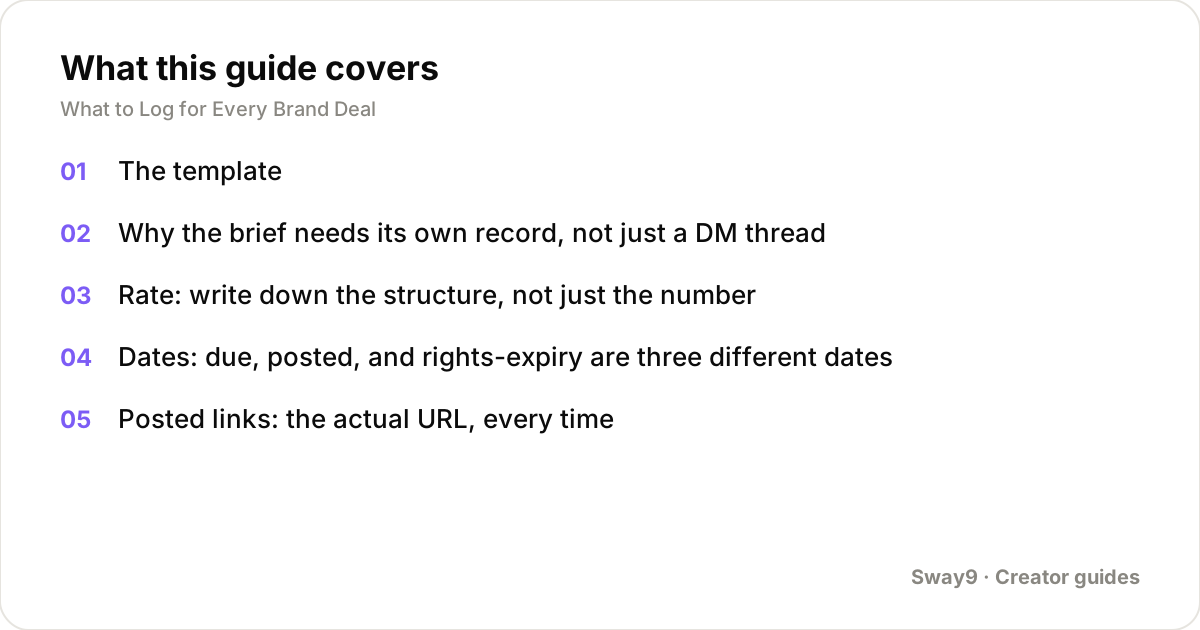
The template
Six columns, one row per deal, or one row per post if a deal has several with different dates. Fill it in when the deal is agreed, not after the content is posted. Most of these fields are things you should already know before you start filming.
| Field | What to record | Example |
|---|---|---|
| Brief | What the brand actually asked for: talking points, must-avoids, format, length | 1x TikTok, 30-45s, show the app opening screen in first 3s, mention the discount code, no comparisons to named competitors |
| Rate | Flat fee or CPM, and the agreed amount | $180 flat per video, or $4 CPM if performance-based |
| Dates | Content due date, agreed post date, and campaign end date if usage rights are time-limited | Draft due Sept 3, post live by Sept 10, usage rights expire Dec 10 |
| Posted links | The actual URL of each live post, not just 'posted' | tiktok.com/@handle/video/123456789 |
| Usage rights | Whether the brand can reuse the post as an ad, whitelist it, or repost it, and for how long | Whitelisting granted for 60 days from post date, organic-only after that |
| Payment status | Invoiced date, due date, and paid date, tracked separately from content status | Invoiced Sept 11, net-30, due Oct 11, paid Oct 9 |
Why the brief needs its own record, not just a DM thread
The brief is usually the first thing agreed, and the first thing that gets hard to find again. It lives in a DM thread or an email chain that keeps scrolling. Write down the concrete asks — format, length, must-include and must-avoid points — in one place. Then if a brand asks for a revision outside what was briefed, you have something to point to.
This matters most when a brief changes mid-deal, which happens more than people expect. If the brand asks for a change after you've logged the original brief, log the change too, with a date. Don't edit the original entry — you want a record of what the ask was at each point.
Rate: write down the structure, not just the number
A rate isn't just a number. It's a number plus a structure — flat per post, CPM, or CPM with a floor. All three can look similar on the invoice while meaning very different things if a post underperforms or overperforms. Logging '$180' without noting whether that's flat or a CPM estimate leaves room for disagreement later.
If the rate has multiple parts — a content fee plus a separate usage-rights fee, say — log each part separately. It's much easier to check whether you were paid correctly against three line items than against one lump sum you have to mentally unbundle.
Dates: due, posted, and rights-expiry are three different dates
It's tempting to track a single 'deadline' date. A brand deal usually has at least three dates: a content due date, a post date, and a usage-rights expiry date.
Conflating them causes real confusion. A creator can think a deal is fully wrapped when the brand still has whitelisting rights running for another month. Or they assume rights have lapsed when they haven't.
Posted links: the actual URL, every time
Log the direct link to each live post, not a note that says 'posted.' This sounds obvious until a deal has three deliverables across two platforms. Two months later, you need to check whether one is still live, or a brand asks for proof and 'yes I posted it' won't satisfy anyone.
The link also connects the deal record to whatever tracks your actual views. Without it, a post's performance and the deal it belongs to are two separate facts you hold in your head. With it logged, a deal's total value is just a matter of summing its linked posts.
Usage rights: the field that costs the most money when it's skipped
Usage rights mean whether a brand can run your post as a paid ad, whitelist it to their ad account, or repost it on their own channels. These are commonly granted for a limited window, not forever, and priced separately from the content itself.
If this isn't logged with a clear expiry date, two things go wrong. You can't tell a brand confidently when their rights have lapsed if they ask. And you have no record to point to if a brand keeps running your content as an ad past the window you agreed to.
Log it as its own field even when nothing beyond an organic post was granted. 'Organic only, no whitelisting' is a useful line to have on record — the absence of a right matters as much as the presence of one.
Payment status: separate from whether the content is done
Payment status and content status move independently. A deal can be fully delivered and posted while payment is still 30 or 60 days out. Conflating the two into one status field hides that. Track invoiced date, due date, and paid date as three separate pieces, so 'what's overdue right now' is a question you answer by checking dates.
The due date itself is arithmetic, not a guess, once you know the invoice date and the terms. Net-30 means the due date is the invoice date plus 30 days. Net-60 doubles that. See the worked example below.
Where Sway9 fits in: each brand deal is set up as a campaign with its rate. The app tracks views and computes what the deal is worth as they come in. CSV export covers pulling the numbers into a spreadsheet for a specific conversation.
It doesn't replace logging the brief, usage rights, or payment status by hand. Those still live in your own record. But it removes the part of the six fields that would otherwise mean pasting in view counts.
Frequently asked questions
Do I need to log this much detail for a small $50 deal?
A lighter version is fine for genuinely small, one-off deals — brief, rate, and posted link cover most of the risk. Usage rights and payment status matter more as the rate goes up and the deal involves more than one organic post. Those are the fields where a dispute actually costs money.
What if the brand never sends a written brief, just a call or a DM?
Write your own summary of what was discussed and send it back as confirmation. Something like: 'just to confirm — 1x TikTok, 30-45s, mention the code, due the 3rd.' This creates the written record. It also gives the brand a chance to correct any misunderstanding before you start filming.
How long should I keep this record after a deal is paid and closed?
At least as long as any usage rights you granted remain active, since that's the period when a dispute about reuse is most likely. Many creators keep the full record indefinitely — it's a small amount of data per deal, and useful history for next time.
What counts as 'usage rights' beyond just posting the video?
Three common categories. Organic-only means the brand can't repost or promote it beyond your own feed. Whitelisting means the brand can run it as a paid ad through your handle, usually for a set number of weeks. Full usage rights or a buyout means the brand can repost, edit, or run the content as its own asset. Each is typically priced differently.
Should I log deals that fell through before anything was posted?
A short note is worth keeping — brand, date, and roughly why it didn't happen — mainly so you have context if the brand reaches out again. It doesn't need the full six-field treatment, since there's no rate, dates, or rights to track without a signed deal.
Track your own accounts
Add your TikTok and Instagram handles, set each brand deal up as a campaign with its rate, and Sway9 pulls in every post and view and works out what the deal is worth. From $22/mo, cancel any time.
Get started Cancel any time · unlimited team members on every plan