Rates · for creators
Usage Rights and Whitelisting: What to Charge
- Usage rights (running your content as a paid ad or on owned channels) and whitelisting (running ads through your own account) are two distinct asks, priced separately from the content.
- Price both as a multiple of your base content rate, scaled up for longer duration and for any exclusivity that blocks you from working with competitors.
- Put an end date on every usage grant — indefinite usage with no renewal point is worth more than most brands actually offer.
Usage rights and whitelisting are two different things a brand can ask for on top of the content itself. Both are priced separately from what you charge to make the video.
Usage rights mean the brand can run your video somewhere beyond the organic post — as a paid ad, on their own channels, in an email. Whitelisting is more specific. The brand runs the ad through your own account's ad permissions. It appears to come from you, with your engagement history attached, even though they are paying to boost it.
Neither is included in a standard content fee, unless you say so. Both are usually priced as a multiple of your base rate, not a flat add-on. What you are selling scales with how long the brand keeps using it, and how exclusively they get to.
What usage rights actually grant
When you post a video organically, you own it and the brand gets the post as it naturally performs. Usage rights are the brand's permission to take that same video and run it somewhere else, on their own terms.
That could be a paid ad on their channels, on their website, in an email, or in other paid placements. None of it involves your account or your organic reach.
This is worth money separately from the content, because the brand is no longer paying for your audience's reaction to a post. They are paying to reuse an asset you made, on their own distribution, for as long as the rights last.
What whitelisting adds on top of that
Whitelisting goes a step further. The brand gets access to run paid ads through your account specifically, rather than their own. So the ad shows your handle, your follower count, and your engagement history to the platform's ad system, and to anyone who sees it.
This typically performs better for the brand than an ad run through their own account, because it inherits some of your account's trust and targeting signal.
You are handing over a form of access to your account, not just a finished file. So whitelisting is priced above plain usage rights. Be specific about what access is actually granted. Most platforms let a brand run ads as you, without giving them posting or messaging access — and that boundary should be explicit before you agree to anything.
The two variables that set the price: duration and exclusivity
Two things drive the price up from your base content rate. The first is how long the brand gets to use the content. The second is whether using you blocks you from a competing brand for a period.
A short usage window with no exclusivity is the cheapest add-on. A long window, combined with a category exclusivity clause, is the most expensive. It is closest to taking you off the market for that niche.
A workable structure: set a base usage multiple for a short, standard window — say, four to six weeks, common enough to treat as a default. Add a further multiple for any extension of that window. Add a separate multiple again if the brand wants exclusivity within your niche for the same period.
Worked example
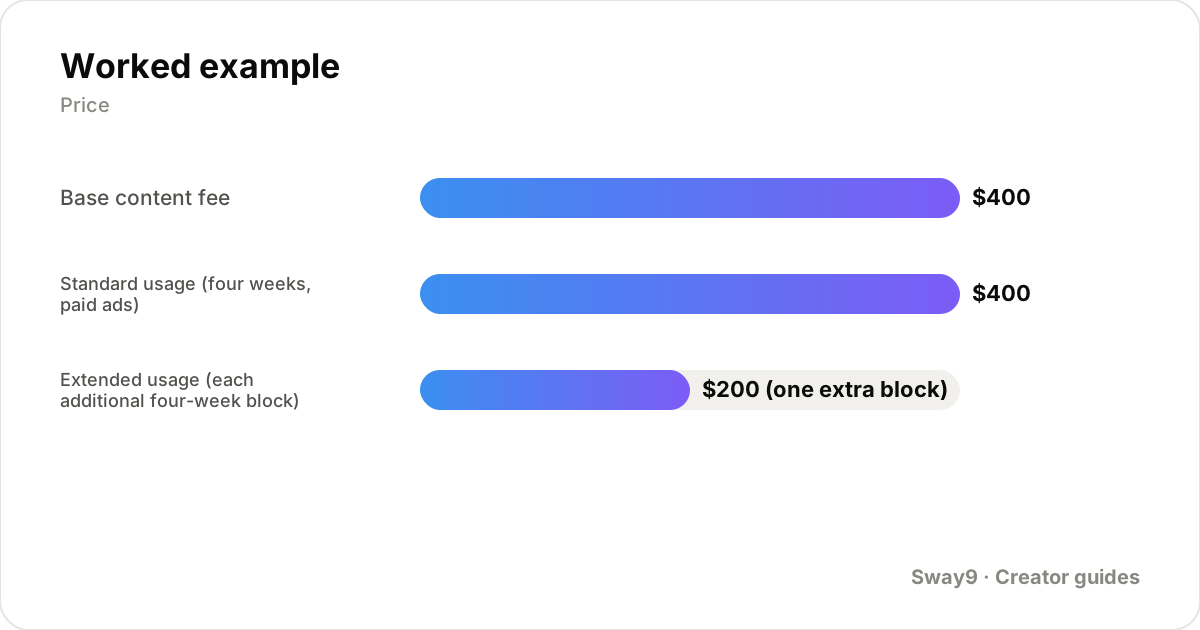
Say your base content rate for the video itself is $400. A brand wants to run it as a paid ad for eight weeks — twice your standard four-week usage window — with no exclusivity requirement.
| Component | Basis | Price |
|---|---|---|
| Base content fee | The video itself | $400 |
| Standard usage (four weeks, paid ads) | 1x base | $400 |
| Extended usage (each additional four-week block) | 0.5x base per block | $200 (one extra block) |
| Whitelisting instead of plain usage | Add 0.5x base on top of the usage price | not used in this example |
Adding whitelisting or exclusivity to the same deal
Take the $1,000 usage deal above and add whitelisting. Access to your account is worth more than a plain file handoff, so add roughly half the usage price again on top.
Put an end date on everything
The single most common mistake is granting usage or whitelisting with no end date, for a one-time fee. Once that happens, the brand can run the ad indefinitely at no further cost. You have no natural point to renegotiate.
Every usage or whitelisting grant should have an explicit expiration. After that, the brand either stops running it, or pays again to renew. The renewal price is a fresh negotiation, not an automatic continuation of the first number.
This matters more the better a piece of content performs as a paid ad. Say a brand keeps a video running for a year, because it converts well. Over that year, it is worth far more to them than the one-time fee you might have accepted up front. A renewal point is the only mechanism that lets you capture any of that.
Keeping track of what you have granted and when it ends
Once you have more than one or two usage or whitelisting deals running at a time, there is a real risk. You can lose track of which brand's rights expired when.
Sway9 sets up each brand deal as a campaign with its rate. At minimum, the content-fee side of a usage deal is tracked alongside its post performance. Treat the usage window and any exclusivity end date as terms you log against that same campaign, so a renewal point never quietly turns into an indefinite one.
Frequently asked questions
Is whitelisting always more expensive than plain usage rights?
Yes, because you are granting a form of access to your own account, not just a file. The exact premium is negotiable. But it should never be priced the same as usage rights on a file the brand runs through its own account.
What is a reasonable default usage window if a brand does not specify one?
Four to six weeks is a common default to propose, precisely because it forces the conversation rather than leaving the window undefined. Whatever you propose, put it in writing. An unstated assumption should not later be treated as indefinite.
Should exclusivity be priced even if the brand is not a direct competitor to anyone I currently work with?
Yes, because exclusivity restricts who you can work with in the future, not just who you currently work with. Price it on the size and activity of the category, not on your current roster of brand deals.
Can I charge for usage rights on content a brand already paid me flat for?
Only if the original agreement did not already include those rights. Read back through what was actually agreed, before assuming a new charge applies. If the flat fee was silent on usage, clarify and price it before the brand starts running it as an ad, not after.
Does a shorter platform (like a Reel or a TikTok video) get a lower usage rate than a longer video?
The usage price should track the value of using the asset as an ad, not its runtime. A short video that performs well as a paid ad is not inherently cheaper to license than a longer one. Base the rate on the usage terms — duration, exclusivity, whitelisting or not — not on how long the clip happens to run.
Track your own accounts
Add your TikTok and Instagram handles, set each brand deal up as a campaign with its rate, and Sway9 pulls in every post and view and works out what the deal is worth. From $22/mo, cancel any time.
Get started Cancel any time · unlimited team members on every plan