Managing a roster · for talent managers
Talent Manager Commission Structures, With Worked Examples
- A flat percentage (commonly 15-20%) is simplest: it pays a manager only in proportion to deal value, with no ceiling either way.
- A tiered percentage drops as a creator's earnings grow, rewarding a manager for finding deals early on.
- A retainer plus commission pays for admin work regardless of deal flow, which suits creators who need heavy day-to-day management.
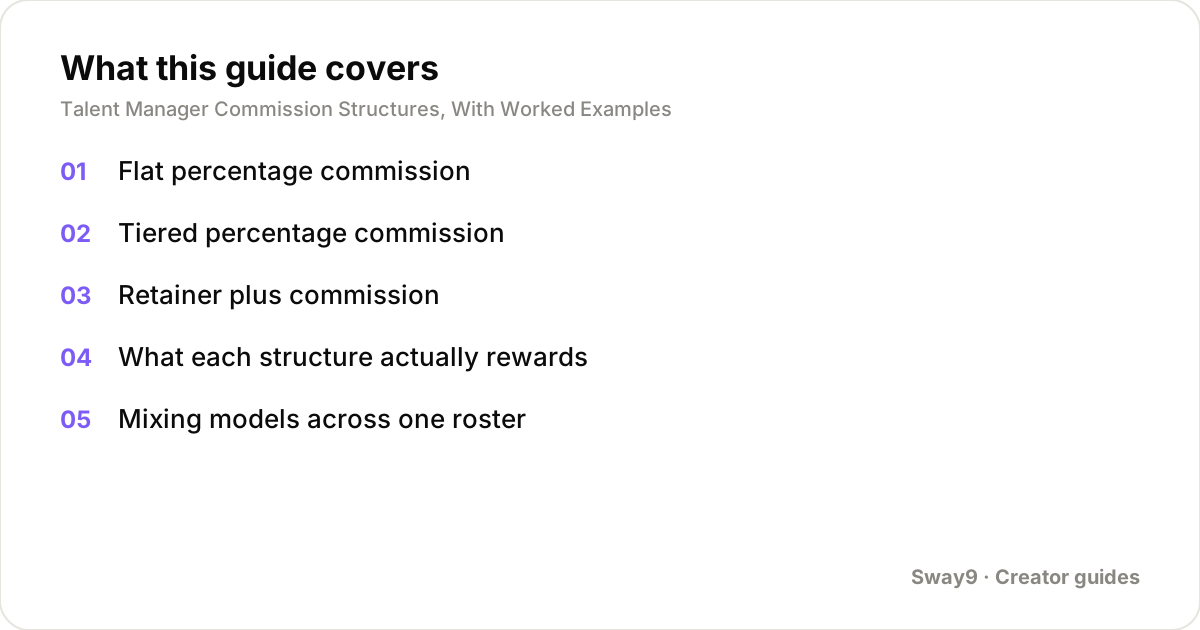
Most talent managers use one of three commission structures. A flat percentage of what the brand pays. A tiered percentage that drops as a creator's earnings climb. Or a smaller retainer plus a percentage on top. Which one fits depends on two things: how much of the deal-sourcing work is actually yours, and how big the roster's deals typically are.
The rest of this article works through all three, with real numbers. It also covers what each one rewards you for doing. The commission model isn't just an invoicing detail — it changes what you're motivated to spend time on.
Flat percentage commission
This is the simplest structure. The manager takes a fixed percentage of whatever the brand pays for a given deal, no matter the deal size. Common rates run 15-20%, though this varies by market and by how much sourcing and negotiation the manager actually did.
On a $150 flat-rate deal at 20%, the manager takes $30. The creator nets $120. A CPM deal — priced per 1,000 views instead of per post — works the same way once you know its total value. The rate is easy to explain and easy to audit: multiply the deal value by the agreed percentage, every time.
Tiered percentage commission
A tiered structure lowers the manager's percentage as a creator's monthly earnings climb past set thresholds. Think of it like a tax bracket. The manager does similar work sourcing the first few deals, no matter the creator's size. Past a certain point, a bigger creator lands extra deals partly on their own reputation. So the commission on that extra portion drops.
Take a structure of 20% on the first $2,000 earned in a month, 15% on the next $3,000, and 10% on anything above $5,000. A creator who earns $6,200 that month owes $970 in total commission — an effective rate of 15.6%.
That's lower than the flat 20% a smaller creator would pay on their first $2,000 alone. And the manager never has to renegotiate as the creator grows.
Retainer plus commission
A retainer plus commission structure pays the manager a fixed monthly fee, no matter deal flow, plus a smaller percentage on top of deals closed. This suits creators who need ongoing day-to-day management — negotiating, scheduling, brand relationships, DMs — more than they need someone purely to find deals. The retainer covers that admin time even in a slow month.
A $500 monthly retainer plus 10% commission works out to $900 in a strong month, when the creator closes $4,000 in deals. In a slow month, closing only $800 in deals, the manager still earns $580. The retainer is what makes taking on an inconsistent creator worth the time.
What each structure actually rewards
A flat percentage rewards the manager in direct proportion to deal size, with no ceiling. It's simple. But it gives no particular reason to favor a smaller creator's deals over a bigger one's — the manager earns the same share either way.
A tiered structure specifically rewards finding a creator's first deals, where the percentage is highest. It tapers off exactly when a creator's own reputation starts doing some of the sourcing work. That tends to keep managers motivated to build newer creators up, not just chase the roster's biggest names.
A retainer plus commission pays for time spent, not just deals closed. That matters for creators whose value to the agency is mostly in reducing their own admin load. The trade-off: a retainer is a cost the agency carries even in a dead month. So it only makes sense once you're confident a creator is worth that ongoing floor.
Mixing models across one roster
Nothing requires one commission structure for the whole roster. A flat percentage suits creators the agency sourced and signed cold. A lower percentage suits creators who arrived with existing brand relationships. A retainer plus commission suits a handful who need heavy day-to-day management, no matter deal volume.
What matters is that each creator's agreement states the exact percentage, and the exact base it applies to. That way there's no ambiguity when a deal closes.
It's worth revisiting the mix periodically, rather than treating it as fixed at signing. A creator who joined on a flat percentage, because they needed heavy sourcing help, can reasonably move toward a lower rate. Or toward a tiered structure, once they're generating steady inbound interest on their own.
Commission on gross or net — decide this before the first deal
Every structure above assumes a clear answer to one question: commission on what, exactly? Gross deal value (what the brand pays in total) and net value (after platform fees or other deductions) can differ meaningfully. A percentage that sounds identical produces a different dollar amount, depending on which base it's calculated against.
Write the base into the agreement explicitly, rather than leaving it implied. It's a common source of disputes once real money is involved.
This matters most on deals with a usage-rights or whitelisting fee bundled in alongside the content rate. Say a $500 deal splits into a $350 content fee and a $150 usage-rights fee. A commission on the full $500 is a different number than one calculated only on the content portion.
Neither approach is wrong. But the agreement needs to say which one applies before the first deal like this closes, not after.
Frequently asked questions
What's a typical commission percentage for a talent manager?
Most flat-percentage arrangements fall between 15% and 20%, though it varies by market and by how much sourcing work the manager does. There's no single standard rate. What matters is that the percentage and its base are written down clearly.
Should commission apply to deals a creator finds on their own?
Many agreements lower the commission, rather than removing it, on deals a creator brings in themselves. The agency may still handle contracts, invoicing and reporting, even when it didn't source the deal. This is worth deciding explicitly, not assumed.
How do tiered commission thresholds usually get set?
They're typically set against a creator's own recent earnings. The first tier roughly matches a slow month; the top tier only kicks in once a creator is comfortably past that. There's no universal threshold. Revisit the tiers whenever a creator's typical earnings shift enough that they stop telling a slow month from a strong one.
Does a retainer replace commission or sit alongside it?
Alongside it, in most agreements. The retainer compensates for ongoing admin time regardless of deal flow, and the commission on top still rewards the manager for the deals that do close.
How often should a commission structure be reviewed?
At renewal, or roughly once a year. Also any time a creator's earnings change enough that the original tiers or retainer no longer reflect the actual work involved.
Track your whole roster in one place
Every creator's accounts, every deal set up as a campaign with its rate, every post and view pulled in automatically. From $22/mo for 25 tracked accounts, unlimited team members, no per-seat fees.
Get started Cancel any time · unlimited team members on every plan