Getting deals · for creators
Red Flags in Brand Deal Contracts
- Perpetual usage rights and broad exclusivity both have real value to the brand — price them or time-box them rather than granting them by default.
- Payment tied only to a subjective 'approval,' with no timeline or criteria, can leave you unpaid indefinitely — ask for a deadline and clear rejection grounds.
- Unlimited revisions collapse your effective hourly rate the more rounds a brand asks for — cap the rounds included, and price extras.
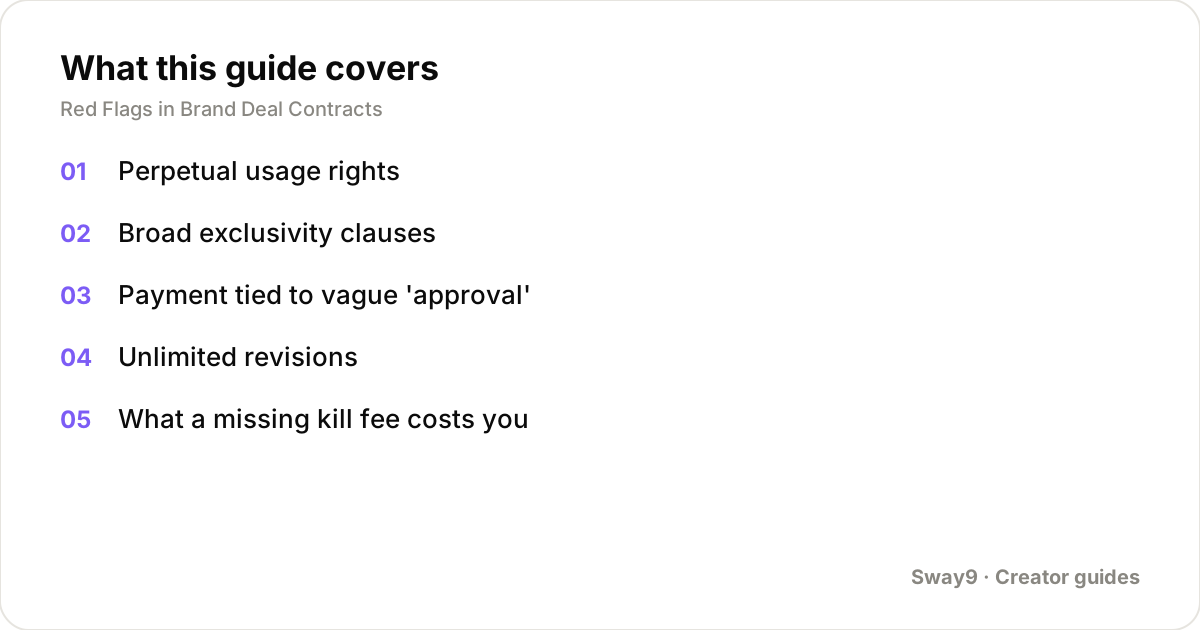
Four terms show up often enough in brand deal contracts to check every time. Perpetual usage rights. Broad exclusivity. Payment tied to vague approval language. Unlimited revisions. None are automatic dealbreakers — brands ask for all four regularly. But each one shifts risk onto you, in a way worth pricing or negotiating rather than accepting by default.
This isn't legal advice. A contract that's unusual or high-value is worth an actual lawyer's read. What follows is what each term does in practice, and a plain question or counter-proposal for each one.
Perpetual usage rights
A usage rights clause says what the brand can do with your content beyond the organic post. That could be running it as a paid ad, putting it on their own channels, or using it in a future campaign. 'Perpetual,' or 'in perpetuity,' means that right never expires. That's very different from a usage window of, say, six or twelve months.
Perpetual usage has real ongoing value to a brand — they never have to renegotiate or repay you to keep using a post that's working. If a contract asks for it, price it as its own line item. That could be a higher one-time fee than a time-limited license. Or it could be a separate renewal fee, if they want to keep using it past an initial window.
A reasonable counter is a defined term — six or twelve months is common — with an option to extend at an agreed additional fee. That's better than granting perpetual rights at the same price as a time-limited one.
Broad exclusivity clauses
Exclusivity says you won't work with competing brands. Sometimes that's within a narrow category and window; sometimes it's broad and long. Read the clause on three points before you sign.
Exclusivity has a real, calculable opportunity cost. Say you typically land two deals a month in a category at $300 each — that's $600 a month from that category alone — see the worked example below. If the contract doesn't call out a separate exclusivity fee, ask for one. Or ask to narrow the category and the window.
- How broadly 'competitor' is defined
- How long the exclusivity lasts
- Whether it's paid for on its own, or bundled into the base rate
Payment tied to vague 'approval'
A clause that pays you 'upon approval,' with no further detail, is worth questioning on two points. What specifically counts as approval? Is there a deadline for the brand to approve or reject? Without both, 'approval' can function as an open-ended delay. The brand can sit on your submission indefinitely without technically breaching anything.
A workable version names the review window: for example, five business days to approve or request revisions. It also states what happens if the brand goes past that window. The content is deemed approved, and payment is due. Ask for both pieces if either is missing. It costs the brand nothing to agree to a reasonable deadline — if they push back, that tells you something.
Unlimited revisions
A clause allowing 'unlimited revisions,' or 'revisions until approved,' with no cap, turns a fixed-fee deliverable into open-ended, unpaid extra work. It directly erodes your effective rate the more rounds get requested.
Take a $200 flat-fee video that took 4 hours to make — that's a $50-an-hour effective rate, see the worked example below. If the brand requests five more rounds of revisions at roughly an hour each, your effective rate collapses. Capping included revisions, commonly one or two rounds, and pricing additional rounds separately keeps the math from collapsing like this.
What a missing kill fee costs you
A kill fee is what you're paid if a brand cancels after you've already started work — scripting, filming, a first edit — but before final delivery. A contract with no kill fee at all means a last-minute cancellation can leave you with hours of unpaid work and nothing to show for it.
Say a $200 deliverable takes 6 hours of prep and filming before the brand cancels — see the worked example below for what that costs you. A common fix is a partial kill fee once work has visibly started. For example, 50% of the agreed fee for a cancellation after filming has begun. That at least partially compensates the sunk time, rather than leaving it fully uncompensated.
A few other terms worth a second look
These four are the most common, but a handful of other clauses are worth reading closely rather than skimming past.
- Raw footage ownership — some contracts ask for the unedited files, not just the final post, which is a broader ask than usage of the post itself
- Indemnification — clauses that put legal liability on you for issues with the product itself, not just your content, are worth flagging to someone with legal training if the wording is broad
- Auto-renewal — a contract that renews automatically unless you cancel by a specific date, buried in a term you might not reread before it renews
How to raise these without killing the deal
Questioning a clause isn't the same as rejecting the deal. Most brands who've been through a few of these negotiations expect some back-and-forth on exactly these terms. Frame it as a specific ask, not a general objection. 'I'd like to time-box the usage rights to 12 months, with an option to extend' reads very differently from 'this contract has a red flag.'
It's also fine to accept a broader term in exchange for a clearer price on it. Perpetual usage at a higher fee, or exclusivity at an explicit rate, are both reasonable outcomes. The goal isn't to strip every clause to the minimum. It's to make sure each one that shifts risk or restricts you is priced or bounded, not silent.
Most brand contracts are a starting template, not a fixed offer. Proposing specific redlines rarely costs you the deal outright. A brand that's used this template across many creators usually has some room to adjust the terms most creators push back on.
Frequently asked questions
Is it normal for brands to ask for usage rights at all?
Yes, very common. The question isn't whether they ask — it's whether the scope, how long, which channels, is bounded and priced appropriately for what's being granted.
Should I ever sign a contract with unlimited revisions?
It's workable if, in practice, the brand has a track record of one clean revision round. But as written, it has no ceiling — that's the risk. Capping it in writing protects you even if you don't expect to need the cap.
What's a reasonable payment deadline after approval?
Net 15 to net 30 days from approval is common in creator deals. Anything past net 45, with no stated reason, is worth asking about directly.
Do I need a lawyer to review every brand contract?
Not every one. A small, standard-looking deal, at a rate you're comfortable with, is usually fine to sign after reading it yourself. A larger or unusual contract, or one with terms you don't understand, is worth the cost of an actual legal read.
What's a reasonable kill fee if there isn't one in the draft?
There's no fixed standard. But 50% of the agreed fee, once work has visibly started, filming or a first draft delivered, is a common, defensible ask. Most brands can agree to it without much friction.
Track your own accounts
Add your TikTok and Instagram handles, set each brand deal up as a campaign with its rate, and Sway9 pulls in every post and view and works out what the deal is worth. From $22/mo, cancel any time.
Get started Cancel any time · unlimited team members on every plan