Rates · for talent managers
Rate Cards for a Creator Roster, Built from Performance
- Base every rate on median views per post, not follower count — a high-follower, low-reach creator shouldn't automatically out-earn a smaller, higher-reach one.
- A target CPM multiplied by median views gives a base rate per post; deliverable type then scales that base up or down.
- A floor underneath the CPM-derived rate protects a smaller or newer creator from being paid almost nothing on a slow post.
A rate card for a creator roster should be built from each creator's median views per post, not their follower count. The two frequently disagree. When they do, follower count is the wrong one to price against.
The method: take a target CPM, and multiply it by each creator's median views. That gives a base per-post rate. Scale that base for deliverable type, and set a floor underneath it.
The worked example below applies this across three creators on the same roster, with very different follower counts. It shows why a performance-based rate card and a follower-based one produce different numbers — and why the performance-based one is the one to actually charge.
Why follower count is the wrong basis
Follower count measures an audience size a platform reports. It isn't what a brand is actually paying for — that's views a specific post gets. The two track together loosely at best.
A creator can accumulate followers from a single viral post years ago, and see a fraction of that number in typical views today. A smaller, newer account can have a median view count well above what its follower count would suggest.
Pricing off followers means pricing off the wrong variable, whenever the two diverge. On a roster of more than a couple of creators, they usually do.
This isn't a hypothetical problem specific to unusual accounts. Follower counts accumulate and rarely go down. View counts move with whatever the platform's distribution is doing for that account right now. That can shift meaningfully in either direction over a few months, without the follower count reflecting it at all.
A follower-based rate card also creates a bad incentive on your side of the negotiation. It rewards a creator for having grown an audience at some point in the past — regardless of whether that audience is currently seeing their content. That's precisely what a brand is paying for.
A performance-based rate card keeps the number tied to what's actually happening now. That's a much easier number to defend, when a brand asks why a rate is what it is.
The two numbers a rate card actually needs per creator
Median views per post, over a recent window of 60-90 days, is the core input. That window smooths out one unusually good or bad post. It doesn't go so far back that an older, different-sized audience skews it.
A target CPM is the second number — what you want that creator to earn per 1,000 views, given niche, platform and typical deliverable. Multiply the two and you get a base rate for a single standard post. Everything else in the rate card scales from there.
Setting the target CPM is a judgment call, not a formula. It's fine for it to differ across the roster.
A creator in a niche where brands pay well per conversion can reasonably sit on a higher target CPM. So can one whose audience skews toward a platform that commands more per sponsored post — even against a creator with similar view counts in a lower-value niche.
What matters is applying whatever target CPM you land on consistently, to that creator's own median views. Don't just pick a rate that feels right for the deal in front of you.
Worked example: three creators, one rate card
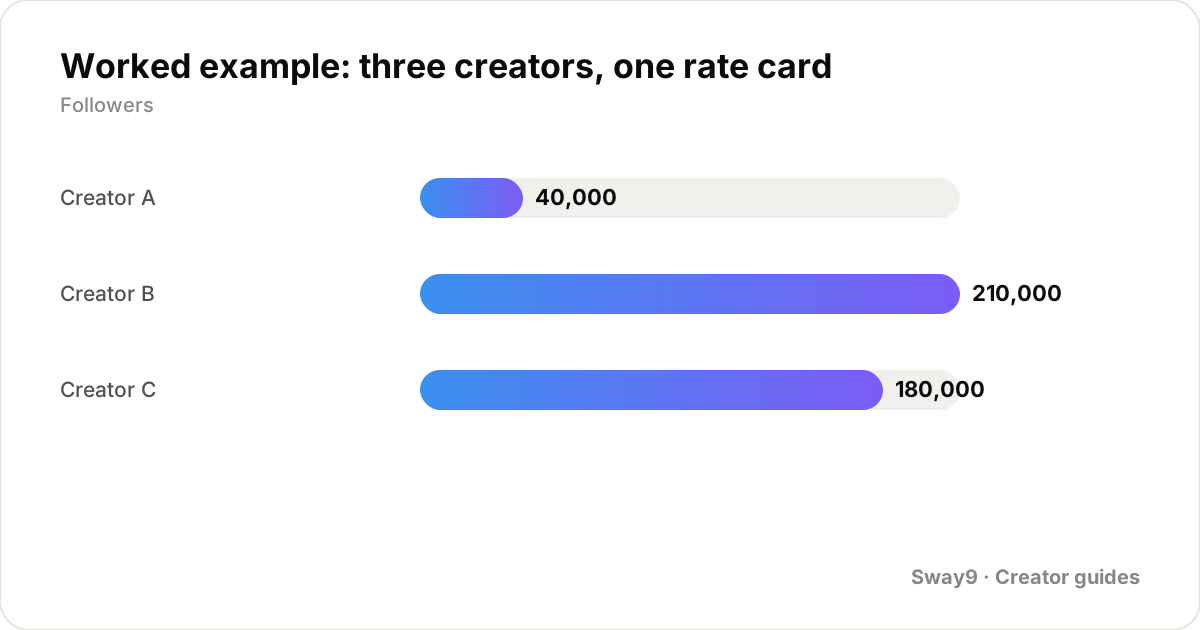
All three creators below are priced at the same $5 target CPM, to isolate what median views alone does to the base rate.
Follower count alone would have priced this backwards. Creator C has more than four times Creator A's followers — 180,000 versus 40,000. But Creator C gets less than a third of the median views: 2,800 versus 9,500. A follower-based rate card would quote Creator C higher than Creator A, for the same deliverable. The performance-based one correctly does the opposite, floor aside.
| Creator | Followers | Median views/post | Base rate ($5 CPM) | Rate actually charged |
|---|---|---|---|---|
| Creator A | 40,000 | 9,500 | $47.50 | $48 |
| Creator B | 210,000 | 32,000 | $160.00 | $160 |
| Creator C | 180,000 | 2,800 | $14.00 | $35 (floor) |
Scaling the base rate by deliverable type
A single in-feed post — the deliverable the base rate above assumes — is the anchor. Other deliverable types scale from it, rather than getting priced from scratch each time.
A common scaling: a Story or short-form add-on at roughly 30% of the base rate. That's for less production time and a shorter view window. A dedicated or longer-form video runs roughly 2x the base rate — more production time, a different format entirely.
Applied to Creator B's $160 base, a Story is about $48 and a dedicated video is around $320.
Usage rights or whitelisting, if the deal includes them, are priced as a separate add-on on top of whichever deliverable rate applies. Don't fold them into the base.
Keep these multipliers consistent across the whole roster, rather than negotiating them fresh per creator. A 30% Story multiplier should mean the same thing for Creator A and Creator C. A smaller creator's Story is proportionally smaller too — it shouldn't become a second axis of inconsistency layered on top of the base rate.
When to move a creator up or down a tier
Revisit the rate card on a fixed schedule — quarterly is reasonable for an active roster — rather than only when a creator asks. A creator whose median views have grown meaningfully since the last review is underpriced at the old rate every month that passes without an update. One whose median views have dropped is a harder conversation, but one worth having before a brand notices the mismatch first.
Treat a single standout post as exactly that, not as the new median. That's the whole point of using the median instead of the average. One viral post shouldn't pull a creator's rate up to a level their typical post can't sustain.
Decide in advance whether a move happens gradually or in one step. Jumping a creator from a $48 base rate to a $70 base rate can read as arbitrary. That's especially true right after their median crosses a threshold, if it isn't explained.
Walk through the median-views change that justifies it — the same arithmetic used to set the rate in the first place. That tends to make the increase feel earned, whichever direction it moves.
Keeping the rate card current without redoing the math by hand
The arithmetic above is simple. Pulling an accurate median views figure for every creator, every quarter, by hand, is the part that tends to slip.
In Sway9, each creator's tracked accounts sync automatically, with a daily history kept per post. A current median is a query away, rather than a manual pull from each account. CSV export gets that figure into whatever document the rate card actually lives in.
Frequently asked questions
Why use the median instead of the average for rate cards?
Because a handful of standout posts can pull an average well above what a typical post actually does. Sway9's own tracking of 159 posts found a median of 307 views. But the top 10% of posts accounted for 26.3% of total views — exactly the kind of skew that makes an average misleading for pricing a typical deliverable.
How often should median views be recalculated for a rate card?
Quarterly is a reasonable default for an active roster. It's frequent enough to catch real growth or decline. It's also infrequent enough that the 60-90 day median window has refreshed with new data since the last calculation.
Should every creator on the roster use the same target CPM?
Not necessarily. Niche, platform and typical deliverable type all justify a different target CPM per creator. The worked example above holds CPM constant deliberately, to isolate what median views alone does to the base rate.
What if a creator's follower count and median views actually do track closely together?
Then a performance-based rate card and a follower-based one will land on similar numbers, and there's no conflict. The method still holds up if the two diverge later, which follower-based pricing alone wouldn't catch.
How should usage rights be added to a rate card built this way?
As a separate line item on top of whichever deliverable rate applies. Use a percentage or flat add-on for the specific usage window and placement. Don't blend it into the base per-post rate.
Track your whole roster in one place
Every creator's accounts, every deal set up as a campaign with its rate, every post and view pulled in automatically. From $22/mo for 25 tracked accounts, unlimited team members, no per-seat fees.
Get started Cancel any time · unlimited team members on every planSources: Sway9 — What 159 tracked UGC posts actually looked like