Getting deals · for creators
How to Turn One Brand Deal Into Repeat Work
- Send a short, unprompted results recap after the campaign ends — most creators never do this, and it's what gets you remembered.
- Reliability — hitting deadlines, responding promptly, delivering what was briefed — is what makes hiring you again the easy choice over finding someone new.
- Pitch the next campaign using the actual numbers from the last one, not a fresh cold pitch — it's a stronger conversation.
A brand becomes a repeat client through three things, done in order. You report on the campaign's results without being asked. You're reliable enough that hiring you again is an easy decision. You pitch the next campaign using the first one's actual numbers, not a cold pitch. Most creators do the work and wait to be asked back. The ones who get asked back have usually done the first two steps already.
Below is that sequence, laid out by when it happens. During the campaign, right after it ends, a few weeks later, and when you propose the next one.
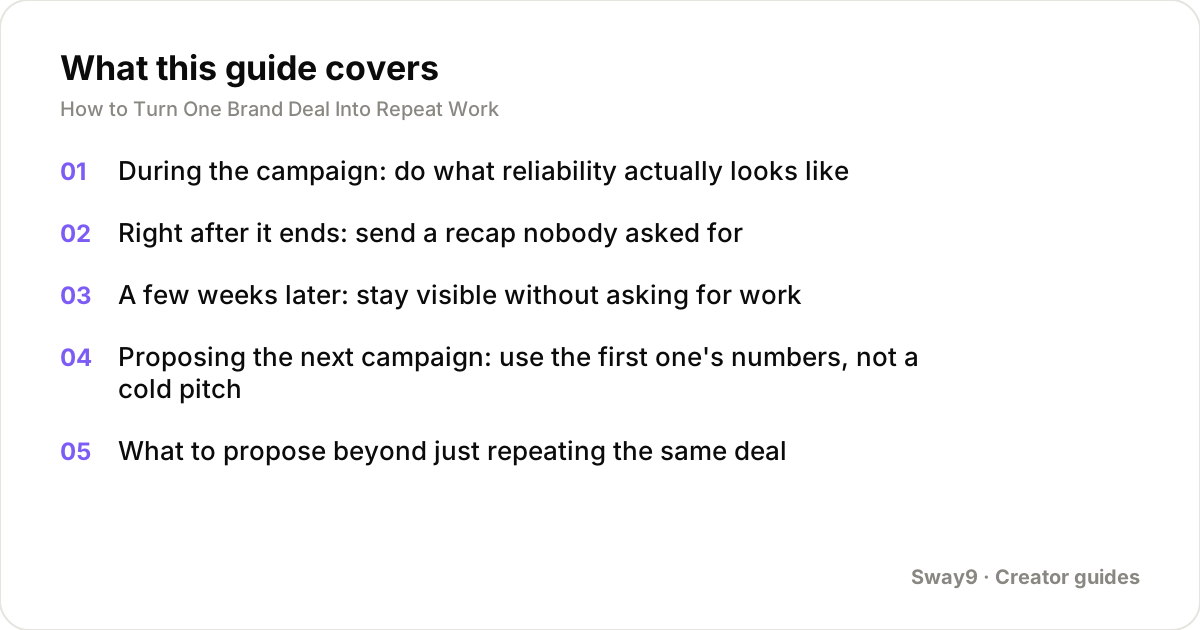
During the campaign: do what reliability actually looks like
Repeat work starts before the first campaign even ends, in how the first one goes. Deliver on the date you agreed to, or flag it early if you won't. Confirm the brief back in your own words before you start filming, so there's no mismatch discovered later. Respond to messages within a reasonable window, rather than going quiet mid-campaign.
None of this is exciting advice. But it's disproportionately what determines whether a brand thinks of you again. A brand who ran one clean campaign with you, with no chasing and no surprises, has a much lower bar to clear before hiring you a second time. That's true however good the content ended up being.
Right after it ends: send a recap nobody asked for
Most creators consider the job done once the post is up and the invoice is sent. Sending a short recap of what the post actually did costs you ten minutes. It's a couple of sentences, not a full report. It's also genuinely uncommon enough that it stands out.
Keep it brief: the post's view count and engagement rate, one line on how that compares to your typical post, and a thank-you. See the worked example below. You're not asking for anything in that message. You're giving the brand a reason to think of you again next time they're planning a campaign.
A few weeks later: stay visible without asking for work
There's a useful middle step between the recap and pitching a second campaign directly: staying visible without it reading as a sales pitch. Say a later post of yours does unusually well, and it's remotely relevant to the brand. A one-line note keeps you in view without asking for anything — see the worked example below.
This works because it's information, not a request. It's easy for a brand to read it and forget, or to quietly file you under creators worth going back to. Either way, it puts no pressure on them to respond with a yes or no.
Proposing the next campaign: use the first one's numbers, not a cold pitch
The second pitch to a brand you've already worked with should look nothing like a first pitch to a stranger. You have real data from your work together. Using it is both more persuasive and less effort than writing a new cold pitch from scratch.
Say your first deal was a single video at a $150 flat rate that landed 9,200 views — see the worked example below for the effective CPM. Proposing a three-video package at that same CPM projects to roughly $106 a video, using your median of 6,500 views.
For three videos, that's about $318 total. Framing it this way — here's what worked, here's the projection at the same rate — reads as a fundamentally different conversation than reintroducing yourself.
What to propose beyond just repeating the same deal
A second deal doesn't have to repeat the first exactly. If the first campaign performed well, a natural next step is a small package instead of a single post. That's a smaller ask for the brand than negotiating a new one-off each time. If a particular format or hook worked especially well, propose more of specifically that, rather than a generic 'let's do this again.'
It's also worth asking directly whether the brand has other products, or a longer program you'd fit. Don't wait for them to think of it. Brands running an ongoing creator program are actively looking for people who've already proven reliable. Telling them you're one of those people, backed by the last campaign's numbers, saves them the search.
Habits that quietly lose a repeat client
A few patterns undo the reliability built up during a good first campaign. Going quiet between deals, and only resurfacing when you need work, is the most common one. A brand notices the difference between a creator who checks in occasionally with something useful, and one who only appears with an ask.
Treating every new deal as a fresh negotiation from zero, ignoring what was agreed or learned last time, also wastes the advantage of an existing relationship.
The other one is inconsistency between deals. Being highly responsive and on-time for the first campaign, then slower or less careful on the second because the relationship feels secured, undoes the goodwill fast. Brands that run creator programs talk to each other internally about who's easy to work with repeatedly. The reputation compounds in both directions.
Keeping the numbers ready without redoing the work each time
Every step above depends on having your own numbers on hand quickly. The recap, the visibility note, and the next pitch all need a current view count and engagement rate. You shouldn't have to dig through screenshots or DMs to reconstruct them.
In Sway9, each brand deal is set up as a campaign with its rate. The app computes what that deal is worth, and its effective CPM, as views come in, with a per-post history behind it. The free plan tracks 3 accounts on 100 credits a month. Paid plans start at $22 a month for 25 accounts, for a manager running repeat relationships across a roster of creators.
Frequently asked questions
How soon after a campaign should I send the results recap?
Within a week or two of the post going up, once you have a view count that's representative, not a first-hour spike. Waiting a month makes the recap feel like an afterthought, rather than a natural follow-up.
What if the campaign didn't perform especially well?
Send the recap anyway, framed honestly — a below-median post with a note on why, a format you're still testing, a slower week, reads better than silence. Silence after a weak post is worse for the relationship than an honest update.
Should I ask for a testimonial or case study permission from a repeat client?
Once you have two or three completed deals with a brand, it's a reasonable ask. Most brands that have worked with you multiple times are comfortable providing a short quote. It strengthens your pitch to other, newer brands.
How do I bring up a rate increase with a repeat client?
Tie it to the numbers, rather than asking in the abstract. If your typical views have grown since the last deal, the effective CPM from your old rate has effectively dropped for the brand. That's a concrete, defensible reason to propose an adjustment.
Is it worth proposing an ongoing retainer instead of one-off deals?
It can be, once you've done two or three campaigns and both sides know the relationship works. A retainer trades a bit of flexibility for predictability on both sides. Some brands running longer programs prefer that over renegotiating each time.
Track your own accounts
Add your TikTok and Instagram handles, set each brand deal up as a campaign with its rate, and Sway9 pulls in every post and view and works out what the deal is worth. From $22/mo, cancel any time.
Get started Cancel any time · unlimited team members on every plan