Tracking · for creators
How to Calculate Your Real CPM Across Accounts
- Real CPM = total earnings across every deal, divided by total views across every deal, in thousands — never average the individual rates.
- Flat-fee deals still count: convert them to an implied CPM using their own views, or keep earnings and views separate and divide only at the end.
- Calculate it per account as well as overall — one blended number can hide an account that is quietly dragging the average down.
Your real CPM is one number: everything you were paid, across every deal, divided by everything those posts earned in views, per thousand. It is not the average of the CPM rates you quoted. It is not any single deal's number either.
It only means anything once you add up earnings and views separately, across every account and campaign, and then divide once, at the end.
This matters if you run more than one account, or more than a handful of deals. Most creators in that spot are quoting different rates to different brands, on accounts that get different views, with no single figure for how it all averages out. The calculation below fixes that, with a worked example across three accounts and four deals.
Why you cannot just average your quoted rates
Say you ran three deals at $3, $5 and $7 CPM. The average of those numbers is $5. But that is not what you actually earned per thousand views, because each deal produced a different number of views.
A $3 CPM deal that got 40,000 views earned you more total money than a $7 CPM deal that got 800 views. It also contributed more views to your total. Averaging the rates weights every deal equally, no matter its size. That is not how the money actually landed.
The fix is two running totals: total earnings, and total views. Divide once, at the end, across everything you want the average to cover.
The calculation, step by step
Do this both for everything combined, and for each account on its own. The combined number is useful for a monthly total. The per-account number tells you whether one account is quietly underperforming the others, once you strip away the different rates you charged on each.
- List every deal in the period you want to measure, across every account: the account it ran on, the rate type (CPM or flat), the rate, and the views the post actually got.
- For each CPM deal, multiply the rate by views divided by 1,000. That is what the deal earned.
- For each flat-fee deal, the earnings are just the flat amount. Still record the views — they count toward the total on the bottom of the fraction.
- Add up earnings across every deal. Add up views across every deal.
- Divide total earnings by total views in thousands. That is your real CPM for the period.
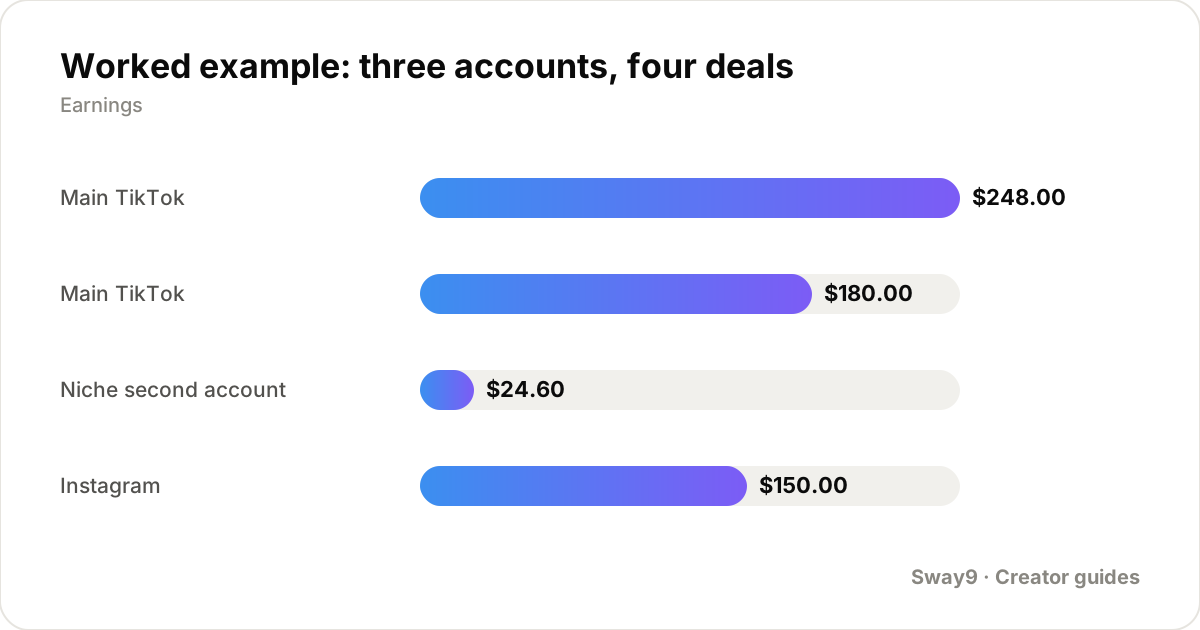
Worked example: three accounts, four deals
Say you run a main TikTok account, a smaller niche second account, and an Instagram account. Last month you closed four brand deals across them.
| Account | Deal rate | Views | Earnings |
|---|---|---|---|
| Main TikTok | $4 CPM | 62,000 | $248.00 |
| Main TikTok | $180 flat | 9,400 | $180.00 |
| Niche second account | $6 CPM | 4,100 | $24.60 |
| $150 flat | 2,900 | $150.00 |
Reading what that number tells you
The $7.69 blended figure is higher than any single CPM rate quoted above. That can look confusing, until you see why: the two flat-fee deals paid well relative to the views they actually got. Once converted to the same per-thousand terms, they pull the blended average up.
That is exactly what a real CPM calculation surfaces, and a list of quoted rates hides.
Where this goes wrong if you skip a step
- Forgetting to include a flat-fee deal's views in the denominator, which understates your real CPM.
- Averaging quoted rates instead of totals, which weights a small deal the same as a large one.
- Measuring views too early, before a post has finished accumulating them — wait a few weeks, not just a day.
- Mixing time periods, like counting a deal's earnings in the month it was invoiced but its views in the month the post ran.
How often to recalculate
Monthly is usually enough to spot a trend. Recalculate per account whenever you are deciding whether to keep investing in a smaller account, or fold its content into your main one.
A niche second account with a real CPM close to your main account's is worth keeping. One that stays far below, even after accounting for its lower rates, is a signal. Its audience is not converting into brand value the way the numbers on paper suggested.
Doing this without a spreadsheet per deal
The manual version works. But it means keeping a running spreadsheet of every deal's rate, views and earnings, and re-pulling view counts by hand.
In Sway9, you add your accounts once. The app pulls every post and its views automatically, up to three times a day. Each deal is set up as a campaign with its own rate, CPM or flat.
The effective CPM shown for a campaign, an account, or your whole workspace is exactly the calculation above, run automatically as views change. It is not a snapshot you have to rebuild each time. The free plan covers 3 accounts. A manager tracking a full roster starts at $22 a month for 25 accounts.
Frequently asked questions
Does real CPM include deals that have not finished paying out yet?
Only include a deal once you know both numbers: what it earned, and what it got in views. If a CPM deal is still running and views are climbing, wait until it settles. Or recalculate the period once it has, rather than mixing a half-finished deal into a monthly total.
Should I calculate real CPM per platform as well as per account?
Yes, if you post the same content to more than one platform under one deal. Splitting by platform can show that one platform is carrying most of a deal's views, even when both were paid the same rate. That is useful information the blended number hides.
What counts as a view for this calculation?
Whatever the platform reports as the public view count, read consistently at the same point in each post's life. For example, always a few weeks after posting, rather than day one for some posts and week four for others.
Is a higher real CPM always better?
It tells you what you earned per view, not whether the deal was a good use of your time. A high real CPM from one flat-fee deal on very few views is a different situation from the same number produced consistently across many posts. The table above is exactly how you tell those two apart.
Should I calculate real CPM before or after platform fees and taxes?
Calculate it on the gross rate the brand paid you, before your own taxes. That keeps it comparable across deals and platforms. Tax and any payment-processor fees are a separate deduction on your total income, not on the per-view rate a specific deal produced.
Track your own accounts
Add your TikTok and Instagram handles, set each brand deal up as a campaign with its rate, and Sway9 pulls in every post and view and works out what the deal is worth. From $22/mo, cancel any time.
Get started Cancel any time · unlimited team members on every plan