Rates · for creators
How Much to Charge per 1,000 Views in 2026
- Reverse-engineer your CPM: take your usual flat rate, divide it by your expected views in thousands.
- Niche, platform and deliverable type change the number — a $4 CPM means different things on different accounts.
- Set a floor, a guaranteed minimum payout, so one slow post does not leave you with almost nothing.
There is no single rate you should charge per 1,000 views. But you can build one that fits you, using numbers you already have.
Start with what you would charge as a flat fee for the same work. Then look at how many views your posts usually get. Divide the flat fee by your expected views, in thousands. That gives you a starting CPM — 'cost per thousand', the rate you earn per 1,000 views.
From there, adjust the number for your niche, your platform, and exactly what you are delivering. This guide walks through each adjustment with one worked example. By the end, you can show a brand the math instead of just naming a price.
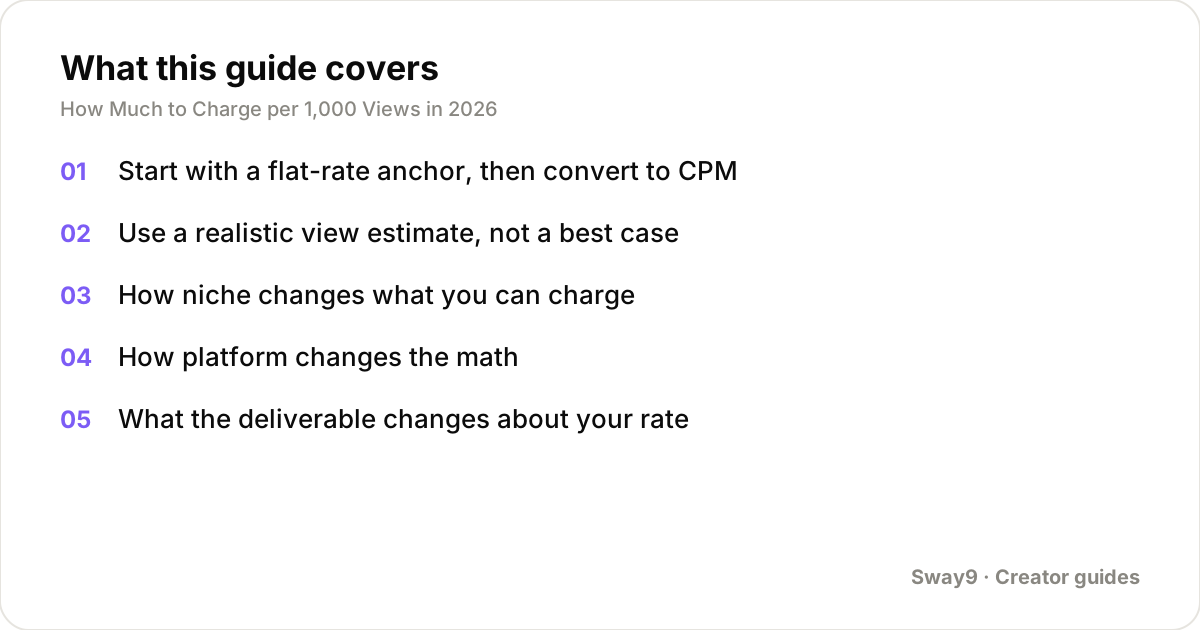
Start with a flat-rate anchor, then convert to CPM
Think about what you would charge a brand for one video, flat, no CPM. That is your anchor number. To convert it into a CPM, divide the anchor by your expected views, in thousands.
Say your normal flat rate is $150 for a video like this. Look at your last several posts of the same type. Take a realistic number, not your best post ever, your typical one.
Use a realistic view estimate, not a best case
The conversion above only works with a realistic view number. Many creators use their best post ever instead. That gives a small CPM number. Then they earn far less than the flat rate they started from.
Sway9 tracked 159 posts across two app campaigns. The median was 307 views per post. 97% of posts got under 1,000 views. A few posts did much better and pulled the average up. That shape — most posts modest, a few carrying most of the views — is common.
Assume this shape for your own estimate, unless your history says otherwise. When you quote a CPM, base your expected views on a typical post. Do not use your best one.
How niche changes what you can charge
Brands set budgets around what a view is worth to them. Not around what it costs you to make the video. A software brand, or a financial product where one signup pays well, can afford a higher CPM. A brand selling a cheap physical product usually cannot. The same 1,000 views is worth more to the first brand than the second.
This is worth asking about directly in a negotiation. Ask roughly what a customer is worth to the brand. You do not need an exact number. You just need a sense of whether this brand can pay more per view, because each conversion matters more to them.
How platform changes the math
The same CPM means different things on different platforms. Typical view counts differ by platform and by account size. An account that usually gets a few hundred views needs a higher CPM to reach a fair payout. An account that usually gets thousands of views needs less. Same rate, very different outcome.
If you run more than one account, or post to more than one platform, do not quote one CPM across all of them. Check what it means in dollars for each account first. A $3 CPM might be fine on an account that reliably gets 5,000 views. On an account that gets 400 views, it is thin.
What the deliverable changes about your rate
A finished, edited post is a different job from raw, unedited footage. A single video is a different job from three hook variations of one script. Each has its own rate, whether you charge flat or per view. The work is different even when the views look similar.
Usage rights and whitelisting are priced separately again, on top of your content rate. That is because you are granting something extra — letting the brand run your video as a paid ad, or through their own ad account.
Two other guides go deeper: one on building a full rate card by deliverable, one on pricing usage rights and whitelisting. If a deal bundles several of these, price each piece and add them up. Do not guess at one number for the whole thing.
Set a floor so a slow post does not pay you almost nothing
A pure per-view rate has one failure mode. If a post underperforms, your payout might not cover the time you spent. Most creators on CPM also set a minimum payout per deliverable. Some add a small base fee on top of the CPM. Others set a flat floor the CPM has to clear before it applies.
Where tracking fits in
Once you agree a CPM, or a CPM plus a floor, the hard part shifts. It is no longer about setting the rate. It is about knowing what you are owed as views come in.
In Sway9, you add your own TikTok or Instagram handles. The app pulls every post and its views automatically, up to three times a day. Each brand deal is set up as a campaign, with its own rate — CPM or flat. Sway9 computes what that deal is worth as the numbers come in.
The free plan covers 3 tracked accounts, with 100 credits a month. Paid plans start at $22 a month for 25 accounts. That tier is built for people managing a roster, not just one account.
Frequently asked questions
What CPM should a new creator start with?
Start with the method above, not a fixed number. Take the flat rate you would ask for the work. Divide it by a realistic view estimate from your own recent posts — not your best post. A newer account, with lower typical views, will land on a higher per-thousand number than an older one asking the same flat rate. That is expected. It is not a red flag.
Should I charge a different CPM on TikTok versus Instagram?
You can use one CPM if your typical views are similar on both platforms. But if one platform reliably gets you far more views than the other, the same CPM pays very differently. Check what your rate works out to in dollars, on each platform, before you agree to one number for both.
Do brands expect to negotiate the CPM?
Often, yes — the same as a flat rate. Come with your math ready: a flat-rate anchor and a realistic view estimate. That tends to make the conversation faster than naming an unexplained number, because the brand can see how you got there.
Is CPM the same thing an advertiser pays for ad impressions?
No. An advertiser's CPM pays a platform to serve an ad a fixed number of times — a guaranteed number. Your CPM as a creator is paid on organic views a post happens to get. That is not guaranteed. It is exactly why a floor, or a flat-fee alternative, is worth considering too.
How do I know what my posts typically get before I have much history?
Use whatever posts you have, even just a handful. Lean toward the lower end of the range, not the high end, until you have more data. If you track your accounts somewhere with a running history per post, pull the median, not the average. A couple of standout posts can pull an average well above what a typical post actually does.
Track your own accounts
Add your TikTok and Instagram handles, set each brand deal up as a campaign with its rate, and Sway9 pulls in every post and view and works out what the deal is worth. From $22/mo, cancel any time.
Get started Cancel any time · unlimited team members on every planSources: Sway9 — What 159 tracked UGC posts actually looked like