Rates · for creators
CPM vs Flat Fee: Which Should You Take as a Creator?
- Work out the breakeven view count first — flat fee divided by CPM, times 1,000.
- Across 159 tracked posts, the median was 307 views, and 97% came in under 1,000 — most posts land well below a typical breakeven.
- CPM makes more sense across a roster of many posts than for one single post.
For a single post, take the flat fee — unless the CPM on offer is high enough to beat it. For most creators, on most posts, it will not.
This is not an opinion. It comes from the math. Compare what a flat fee and a CPM actually pay across three outcomes: a low one, a median one, and a viral one, for the same post.
The two models are not interchangeable versions of the same money. A flat fee pays the same whether the post flops or breaks out. A CPM pays almost nothing on a flop, and a lot on a breakout. Which of those you get is mostly outside your control. Below is the math, using a real distribution of view counts, not a guess.
What each model actually pays you
A flat fee is a fixed number, agreed before the post goes up. You are paid it whether the post gets 50 views or 50,000.
A CPM, or 'cost per thousand', is a rate multiplied by however many views the post gets. The payout is unknown until the views stop moving. For most posts that is within a few weeks, though platforms can keep counting longer.
Neither model is 'better' on its own. A CPM is a bet that your post does well enough to beat the flat rate. A flat fee is the price of removing that bet. Whether the bet is worth taking is a question for a calculator, not a gut feeling.
The breakeven point
The number that matters is the view count where a CPM offer pays exactly what a flat offer would have paid. Below that number, flat wins. Above it, CPM wins.
The formula is simple: breakeven views equal the flat fee divided by the CPM, times 1,000.
Running the same post through three outcomes
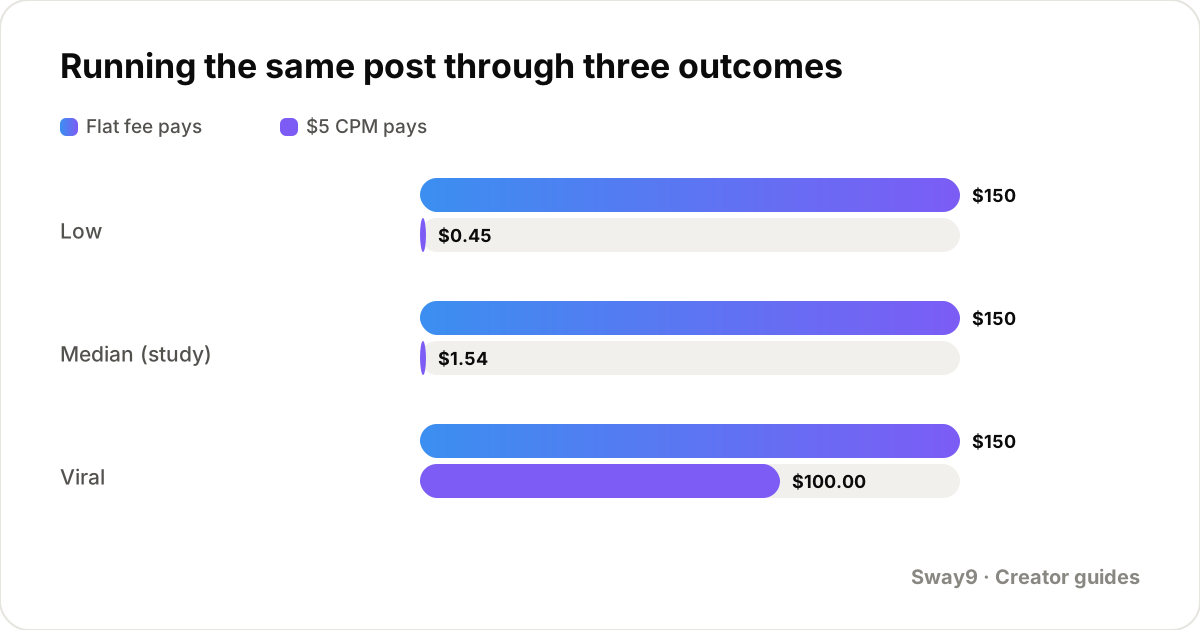
Take that same offer: a $150 flat fee, or a $5 CPM. Here is what each pays under three outcomes — low, median, and viral.
The median figure is not a guess. It is the median of 159 posts Sway9 tracked across two real campaigns. The same study found that 97% of posts landed under 1,000 views. Treat the 'low' and 'median' rows below as the realistic range. Treat 'viral' as the rare exception, not the expectation.
| Outcome | Views | Flat fee pays | $5 CPM pays |
|---|---|---|---|
| Low | 90 views | $150 | $0.45 |
| Median (study) | 307 views | $150 | $1.54 |
| Viral | 20,000 views | $150 | $100.00 |
Reading the table honestly
At the low and median outcomes, the CPM pays a small fraction of the flat fee. That is not because $5 is a bad rate. It is because 90 and 307 views are both far under the 30,000-view breakeven.
Even the viral row, at 20,000 views, still falls short of breakeven. It still pays less than flat. Only a post well past 30,000 views would flip the result.
For one post, from a typical creator, a CPM at this rate is unlikely to beat the flat fee. Most posts land far below breakeven. Only a few land far above it. Raising the CPM rate moves the breakeven down. A brand that insists on CPM should expect to pay a higher per-thousand rate, in exchange for you taking on that risk.
Where CPM starts to make more sense
The calculus changes once you look at many posts, not just one. Say your own history shows a similar shape — most posts modest, a few doing much better. A roster of ten or twenty CPM deals is more likely to include one of those rare high-view posts than any single deal is.
That is the argument for creators who post often, or for managers pricing a whole roster the same way. The CPM you would never take on a single post can pay off across many. You only need one or two deals to clear breakeven for the roster average to look good.
CPM also fits better when a deal is explicitly paying for reach, not just one asset. A whitelisting or paid-usage deal is buying distribution, not just footage. Those deals are usually priced on top of a base content rate, not instead of it. That is a separate topic from the flat-versus-CPM choice on the organic post itself.
Where flat still wins
Take flat when you only have one or two posts in the deal. Take it when your recent history suggests modest views. Take it when you need payment certainty for cash flow. Take it when the CPM on offer implies a breakeven far beyond anything your account has produced.
None of that is pessimism. A single roll of a skewed distribution mostly lands on the low side of it. That is just how the distribution works, most of the time.
If a brand only offers CPM and the rate is low, do not argue the philosophy of it. Ask for a higher per-thousand rate instead. Or ask for a base fee added on top. Or ask for a minimum payout regardless of views. Any of those three moves the breakeven back in your favor.
Tracking whichever model you take
Whichever you agree to, the same question follows a few weeks later: what did this deal actually pay? In Sway9, you set each brand deal up as a campaign with its rate, CPM or flat.
As your connected accounts sync automatically, the app computes the effective CPM on the deal from the real view counts. You are not doing this math by hand, from a spreadsheet.
The free plan covers 3 tracked accounts. Paid plans start at $22 a month for 25 accounts — built for a manager running this same comparison across a roster, not one account.
Frequently asked questions
Is CPM ever a bad deal for the brand instead of the creator?
Yes, it can be. A brand offering a high CPM to a creator whose posts reliably clear a large view count is taking on a real cost. That cost can end up bigger than a flat fee would have been. The breakeven math runs both directions.
Can I ask for CPM with a guaranteed minimum?
Yes, and it is a common middle ground. A CPM with a floor pays the floor if views underperform. It pays the CPM rate if views clear it. That removes the worst-case downside of pure CPM, without giving up the upside.
Does the breakeven view count change by platform?
The formula stays the same. But what counts as a realistic view count for your account does not. Check your own recent posts, on the specific platform the deal will run on, before deciding whether a given CPM's breakeven is realistic.
Should a brand-new account ever take CPM?
Only at a high per-thousand rate, a low breakeven, or with a floor attached. A new account has the least history to judge whether a post might clear breakeven. The safer default is a flat fee, until there is enough of a track record to negotiate CPM with confidence.
How does this change for a deal with several deliverables?
Run the breakeven calculation per deliverable, not on the deal as a whole. A video, a raw-footage cut, and a set of hook variations do not carry the same expected views, or the same amount of work. Blending them into one number hides which piece is actually driving the outcome.
Track your own accounts
Add your TikTok and Instagram handles, set each brand deal up as a campaign with its rate, and Sway9 pulls in every post and view and works out what the deal is worth. From $22/mo, cancel any time.
Get started Cancel any time · unlimited team members on every planSources: Sway9 — What 159 tracked UGC posts actually looked like